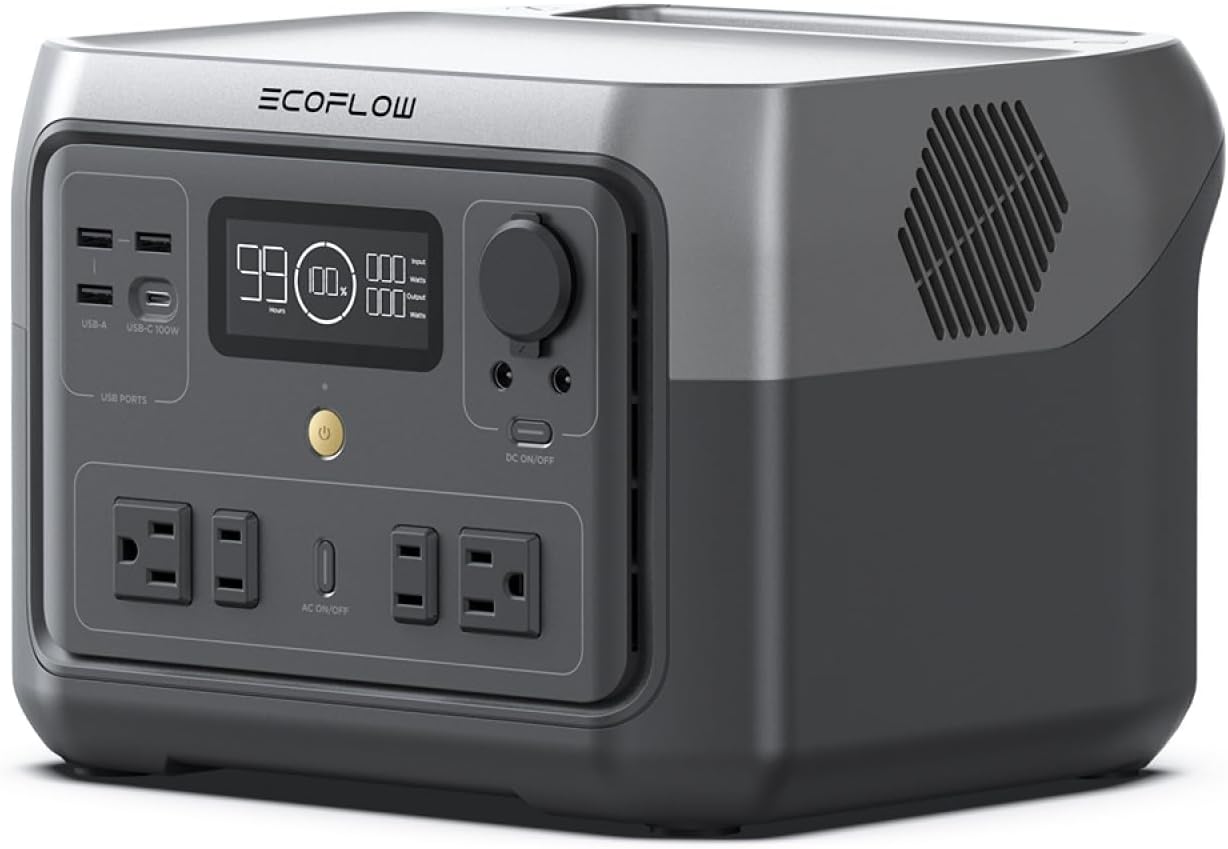
Bluetti EB70 vs EcoFlow River 2 Pro: One Is Discontinued
Bluetti marks the EB70 discontinued and its US replacement is out of stock at $449. The River 2 Pro is $369, recharges in 70 minutes, and has four AC outlets.
By the Ask Versa AI Editorial Team. Ask Versa AI content is AI-assisted and editorially reviewed before publishing; specs and review sentiment are pulled live from Amazon.
Bluetti's own store answers half this question
The EB70 product page on Bluetti's European site carries a notice above the price: "EB70 is discontinued." The unit that replaced it in the US, the EB70S, sits on Amazon at $449 with 1,007 ratings at 4.4 stars and a line under the buy box reading "We don't know when or if this item will be back in stock."
The EcoFlow RIVER 2 Pro, meanwhile, is in stock for $369 at EcoFlow's US store (early Black Friday pricing, running through November 18) and $369 on Amazon with 1,841 ratings at 4.5 stars.
So this is not a normal two-way comparison between two current boxes. It is a 2021 design that the manufacturer stopped selling, up against a unit you can order today with a warranty. That alone settles it for most buyers, and the rest of this page is about the two cases where it does not: you already own an EB70, or someone is offering you one cheap.
The one spec where the EB70 wins
The original EB70 shipped a 1,000W pure sine inverter with a 1,400W surge. The RIVER 2 Pro is rated at 800W continuous with a 1,600W surge, and EcoFlow advertises an X-Boost mode that pushes it to 1,600W for appliances it can emulate.
Continuous rating is the number that matters for anything that runs for more than a few seconds. A 900W electric kettle or a 1,000W coffee maker will run on the EB70. On the RIVER 2 Pro those loads live in X-Boost territory, and X-Boost is not a bigger inverter. The Solar Lab drove a 1,500W space heater through a RIVER 2 Pro and the unit shut down on a voltage fluctuation, with their conclusion being that it "performs best as the 800W inverter it is, with or without X-Boost."
That is the whole case for the EB70, and it evaporates at the checkout page: the US SKU you can still find is the EB70S, which Bluetti rates at 800W continuous and 1,400W peak. Same inverter class as the RIVER 2 Pro, thinner surge.
Four hours against seventy minutes
Both cells are lithium iron phosphate, both land near 716 to 768Wh, and both are rated for thousands of cycles. Charging is where these two stop resembling each other.
The EB70's charger ceiling is 200W, whether that power comes from a wall outlet, a solar panel, or a car. Bluetti quotes 4 to 4.5 hours for a full charge on the EB70S, and 7 to 8 hours from a 12V car port. The RIVER 2 Pro accepts 940W from the wall and goes 0 to 100% in 70 minutes, with a 220W solar ceiling and 100W USB-C input as a third and fourth path.
Seventy minutes against four hours changes how the box gets used. A station that refills over lunch can be treated as a battery you cycle daily. One that needs an afternoon tethered to an outlet gets charged the night before and then treated as a finite tank. Over a two-week trip, that difference shows up more often than 52Wh of extra capacity ever will.
Specs side by side
| Spec | Bluetti EB70 (2021) | Bluetti EB70S (US SKU) | EcoFlow RIVER 2 Pro |
|---|---|---|---|
| Capacity | 716Wh | 716Wh | 768Wh |
| Chemistry / cycles | LiFePO4, 2,500+ to 80% | LiFePO4, 2,500+ to 80% | LFP, 3,000 to 80% |
| AC continuous | 1,000W | 800W | 800W |
| AC surge | 1,400W | 1,400W | 1,600W (1,600W via X-Boost) |
| AC outlets | 2 | 4 | 4 |
| Max AC input | 200W | 200W | 940W |
| Full wall charge | about 4 h | 4 to 4.5 h | 70 min |
| Solar ceiling | 200W | 200W | 220W |
| Weight | 21.4 lb | 21.4 lb | 18.2 lb |
| App control | No | No | Wi-Fi and Bluetooth |
| Price, Nov 2026 | discontinued | $449, out of stock | $369 |
The EB70 column is from Bluetti's product page for the original unit. The EB70S column is from Bluetti's US listing, which is also where the 4-outlet count comes from: the original EB70 lists two AC outlets, and the "S" adds two more. RIVER 2 Pro figures are from EcoFlow's published spec sheet.
If you already own an EB70
Keep it. The capacity gap is 52Wh, roughly seven percent, and both batteries are LFP with a rated life in the same bracket. Replacing a working EB70 buys you faster charging, an app, and two extra outlets for $369. If the complaint is runtime rather than recharge speed, a 200W folding panel runs well under that and plugs into the input the EB70 already has.
The honest trigger for replacing one is a dead cell or a dead inverter, not a spec sheet. If the unit has been sitting at 100% in a garage for three years, check what it actually holds before spending anything: run a known load and time it. A 500W heater should give you a bit over an hour on a healthy 716Wh pack after inverter losses.
If someone offers you an EB70 cheap
Clearance and used listings are where a discontinued model earns its place. The math is simple: a new RIVER 2 Pro is $369 with a warranty, an app, four outlets, and a 70-minute charge. For a used EB70 to beat that, it needs to land near $250 or below, and you need to want the 1,000W inverter specifically, which means a kettle, a coffee maker, or a power tool rather than a laptop and a fan.
Above $250 the trade stops working. You would be buying 2021 cells with an unknown cycle count, no app, a four-hour recharge, and no warranty, to save less than the price of a decent 200W panel. The EB70S listing on Amazon is the one to watch if you want to know when stock returns.
If what you want is a current Bluetti in the same 768Wh class, the AC70 against the RIVER 2 Pro is the live comparison, since the AC70 is the unit Bluetti still sells in that slot. For a smaller box in the same family, the DJI Power 500 vs RIVER 2 Pro covers the sub-600Wh end.
Frequently Asked Questions
Is the Bluetti EB70 discontinued?
Yes. Bluetti's own product page for the EB70 states that the model is discontinued, and the current US equivalent is the EB70S, which Bluetti lists at 800W / 716Wh. The original EB70 carried a 1,000W inverter, so the replacement is a step down in continuous output.
What is the difference between the EB70 and the EB70S?
Rated AC output and outlet count. The EB70 is rated at 1,000W continuous with two AC outlets; the EB70S is rated at 800W continuous with four. Capacity is identical at 716Wh, surge is 1,400W on both, and both take a maximum of 200W of input.
How long does an EB70 take to charge?
About 4 to 4.5 hours from a wall outlet or a 200W solar array, and 7 to 8 hours from a 12V car port, per Bluetti's specs for the EB70S. That 200W input ceiling is the reason the number is measured in hours rather than minutes.
Is 768Wh enough to run a fridge?
For a 12V car fridge drawing about 50W on average, expect roughly 13 to 14 hours from a 768Wh unit once inverter losses are counted. A full-size kitchen fridge pulling 150W or more on its own duty cycle will run for a few hours at most, so plan on a bigger class of station for home backup.
Deciding with a listing in front of you
Spec sheets settle capacity and charge time. They do not tell you which unit has a fan that whines at 62dB under load, or which owner base reports a BMS that trips early. Both of those live in the review text.
Versa AI takes the two Amazon links you are torn between, pulls the live specs, reads through the reviews, and prints the differences that would survive a return window. Paste them in and it takes about ten seconds. No account needed.
Shop smarter with Ask Versa AI
Get occasional product-comparison tips and new features as they ship. No spam.