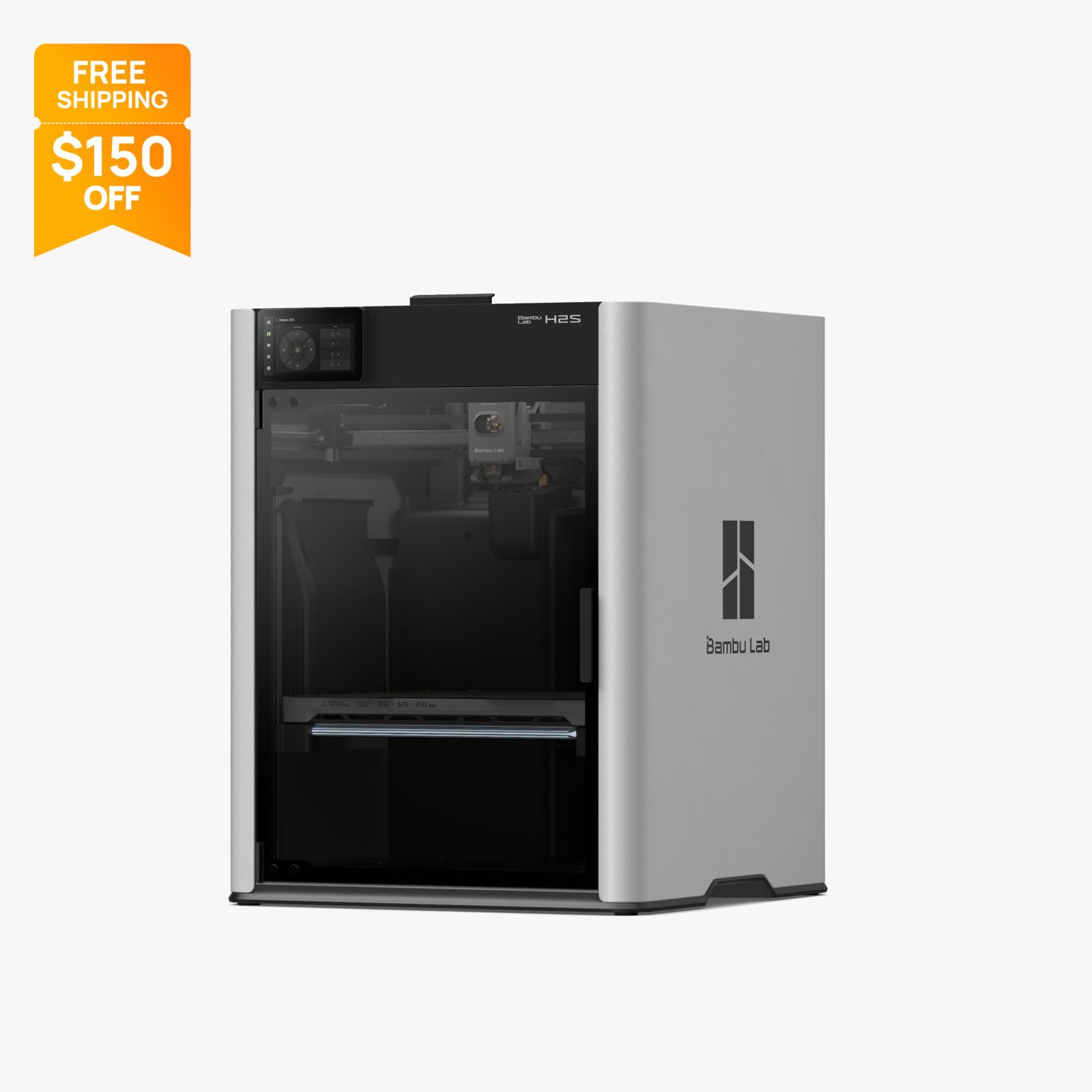
Bambu Lab H2S vs QIDI Plus 5 and Max 4: What $350 Buys
The H2S costs $350 more than a QIDI Plus 5 and the same as a Max 4 with a bigger bed. Compare build volume, 65°C chambers, and what AMS 2 Pro buys.
By the Ask Versa AI Editorial Team. Ask Versa AI content is AI-assisted and editorially reviewed before publishing; specs and review sentiment are pulled live from Amazon.
Three Machines, One Real Question
The Bambu Lab H2S, the QIDI Plus 5, and the QIDI Max 4 all print from an actively heated 65°C chamber with a nozzle hot enough for polycarbonate and carbon-filled nylon. That sentence used to separate $2,000 machines from $500 ones. In November 2026 it separates nothing, because all three sit between $699 and $1,249 on the manufacturers' own stores, and all three are on a Black Friday promotion right now.
So the shopping question is not "which one is better." It is narrower and less flattering to the biggest brand in the room: what are you actually buying when you pay Bambu $350 more than a Plus 5 for the same chamber temperature?
The short answer, which the rest of this page defends: you are buying a color system and a software ecosystem, not a print. The H2S has the most polished multicolor path in the industry and the least fiddly first print. The QIDI pair buy you volume and a hotter nozzle for the money, and ask you to accept a younger ecosystem and a shorter track record.
What They Cost on November 10, 2026
Prices move, so start with the numbers as they stand today, straight from each manufacturer's US store. Both brands are running their Black Friday promotions already, eleven days before the actual date.
| Configuration | Today | List / "typical" price | Black Friday note |
|---|---|---|---|
| Bambu Lab H2S (printer only) | $1,049 | $1,199 | $150 off, Bambu's stated sale runs through November 30 |
| Bambu Lab H2S AMS Combo | $1,249 | $1,399 | Includes AMS 2 Pro — this is the version most people mean |
| QIDI Plus 5 | $699 | $749 | QIDI's Black Friday sale is live on the US store |
| QIDI Max 4 | $1,049 | $1,149 | Polar Cooler bundled as a gift at time of writing |
| QIDI Max 4 Combo | $1,199 | — | Multi-material kit included |
Two things fall out of that table. The H2S with a color system costs $550 more than a QIDI Plus 5, not the $350 the printer-only sticker suggests. And the Max 4 costs exactly what a bare H2S costs while giving you 50 mm more on every axis. If you came here to decide between the H2S and the Max 4, price will not decide it for you.
Specs Side by Side
| Feature | Bambu Lab H2S | QIDI Plus 5 | QIDI Max 4 |
|---|---|---|---|
| Build volume | 340 x 320 x 340 mm | 320 x 320 x 300 mm | 390 x 390 x 340 mm |
| Chamber | 65°C active heating | 65°C active heating | 65°C active heating |
| Max nozzle temp | 350°C | 370°C | 370°C |
| Extruder | Closed-loop PMSM servo | Direct drive, hardened | Closed-loop motors, X/Y |
| Headline speed | 1,000 mm/s, 20,000 mm/s² | 800 mm/s class | 800 mm/s, 30,000 mm/s² |
| Multicolor | AMS 2 Pro (up to 4 units), sold separately | QIDI Box, sold separately | QIDI Box, sold separately |
| Laser / cutting add-on | Yes, 10W and 40W modules | No | No |
| Software | Bambu Studio, MakerWorld | OrcaSlicer-based, QIDI Studio | OrcaSlicer-based, QIDI Studio |
| Launch | 2026 | August 2026 | 2026 |
The X2D and the H2D are not in this table on purpose. If you are shopping a second nozzle, our QIDI Plus 5 vs Bambu X2D comparison and the older H2D vs QIDI Plus 4 breakdown cover those forks. This page is only about the single-nozzle, big-volume branch.
Volume: Only One of These Is Actually Big
340 x 320 x 340 mm is a lot of printer. The Max 4's 390 x 390 x 340 mm is a different category, roughly 40% more usable bed area, and it is the single strongest argument in this comparison.
Here is the honest test. If your parts and assemblies fit inside a 340 mm cube, the H2S's volume is already more than you will use, and the Max 4's extra bed is a feature you pay for and never touch. If you regularly print helmets, drone frames, intake manifolds, or multi-part plates that currently get split across two jobs, 390 mm ends the splitting, and no amount of Bambu polish replaces bed area you do not have.
The Plus 5 is the odd one out at 320 x 320 x 300 mm. It is not a large-format machine. It is a medium enclosed printer with a hot nozzle, which is a different product at a different price, and it is the right one for a lot of people.
Temperature: 370°C vs 350°C Is Narrower Than It Sounds
The QIDI pair runs a 370°C hotend against Bambu's 350°C, a 20-degree edge that matters only at the very top of the material chart. Both machines handle PLA, PETG, ABS, ASA, PC, and most carbon-filled blends. The 370°C ceiling buys you headroom on the highest-temperature polycarbonate grades and the fastest-flowing engineering filaments, where you are running a hot, quick extrusion and a 350°C ceiling starts to bind you.
For everyone else, the deciding thermal spec is the chamber, and it is a tie. All three actively hold 65°C, which is what makes ABS and ASA behave and what separates this tier from an open-frame printer. Bambu layers more instrumentation on top of it, five NTC sensors and airflow sensing with closed-loop fan control, and that is a real reliability edge on long engineering prints. It is not a difference you will notice on a two-hour benchy.
Multicolor: This Is Where the Money Goes
Strip out the hardware and the H2S's premium is a color system.
The AMS 2 Pro is the most mature consumer multi-material feeder on the market. It dries filament while it prints, it feeds four spools with per-slot RFID profiles when you buy Bambu filament, and it integrates with Bambu Studio to the point where a beginner can run four colors without understanding retraction. Bambu also lets you chain multiple units if you want more slots.
QIDI's answer is the QIDI Box, and the honest verdict from early testing is that its color changes are less consistent than Bambu's. The Max 4 and Plus 5 also support multi-material through it, and QIDI's own material handling has improved with each generation. But if the reason you are shopping this tier is "I want to print four-color parts and not think about it," the AMS 2 Pro is the product that does that, and the QIDI Box is the product that mostly does that.
That is what $350 buys. Not a better print, a better color workflow. If you plan to print single-color functional parts, the premium is mostly wasted on you, and the QIDI pair becomes the obvious value.
Speed, and Why the Numbers Are Marketing
Bambu quotes up to 1,000 mm/s and 20,000 mm/s², and claims roughly 30% faster prints than the X1C generation. QIDI quotes 800 mm/s at 30,000 mm/s² on the Max 4. Nobody prints at any of those numbers, because surface quality and part strength fall off long before the toolhead runs out of speed. Real work lands around 150 to 300 mm/s on all three.
What does change the wall clock is the extruder and the calibration. Bambu's closed-loop servo extruder measures nozzle pressure and calibrates pressure advance per filament, which is why its high-flow prints come out even without you tuning anything. QIDI closed the gap with closed-loop motors on X and Y plus a 2 mm lead-screw Z with an anti-backlash nut on the Max 4, and its motion system is genuinely stiff. The difference shows up on tall parts at speed, where the Bambu's compensation is doing more of the work, and on the first print, where Bambu asks less of you.
Ecosystem: The Part You Live With After Week One
Bambu Studio ships verified profiles for hundreds of filaments, MakerWorld does one-click printing from a phone, and the spare-parts pipeline is the best in consumer 3D printing. Two-year warranty, 30-day returns, 30-day price protection at the official store. That last one is worth knowing in a Black Friday window: if the price drops again inside 30 days, Bambu's own policy covers the difference.
QIDI's software moved onto an OrcaSlicer base, which power users prefer for exactly the reasons Bambu users dislike it: more knobs, less hand-holding. Community support is thinner, the track record on the Plus 5 and Max 4 is measured in months rather than years, and long-term belt and bearing wear is genuinely unknown on both. Neither is a reason to avoid the machines. Both are reasons to buy them from a seller with a real return window.
Bambu's other edge here is optional: the H2S takes a 10W or 40W laser and a cutting module, self-installed. If you want one box that prints and engraves, that is a capability the QIDI pair simply does not have, and it is priced into the $1,599 Laser Full Combo rather than the base machine.
Which One
Buy the Bambu Lab H2S AMS Combo ($1,249) if multicolor is the point, if you want the first print to work without calibration, or if you want the laser option later. You are paying roughly $550 over a Plus 5 for the color system and the software, and that is a fair trade for someone who prints four-color parts regularly and unfair for someone who does not.
Buy the QIDI Max 4 ($1,049) if bed area is the constraint. At the same price as a bare H2S it gives you 390 mm on both axes, a hotter nozzle, and the same 65°C chamber. You give up the AMS polish and the ecosystem depth. For jigs, big single-piece parts, and anyone whose current printer forces them to split models, that trade is worth taking.
Buy the QIDI Plus 5 ($699) if you want an enclosed, high-temperature machine and multicolor is optional. It is the value pick of the three, and the $350 to $550 you keep is filament, a dryer, and a spare nozzle set. The 3D printer buying guide covers where it sits against the rest of the field, and the Bambu vs QIDI scorecard tracks the brand-level record across every matchup we have scored.
Buying Them During Black Friday
Both promotions are live as of November 10, and neither is a fake discount. Bambu's H2S is $150 below its own typical price and the store states the sale runs through November 30. QIDI's Plus 5 is $50 below list and the Max 4 $100 below, with a cooler bundled.
That said, two things to check before you pay. First, confirm the "typical price" is a price the machine actually sold at rather than an inflated reference: Bambu's store does 30-day price protection, which makes the comparison easy, and a free tool like Keepa or CamelCamelCamel does the same for anything you buy on Amazon. Second, do not assume the last week of November is automatically cheaper than today. The discount you are looking at is the Black Friday discount, and the deal-timing breakdown explains why waiting for the calendar date is usually worse than watching the actual chart.
If either machine drops further before the 27th, that is a data point, not a reason to panic-buy.
Frequently Asked Questions
Is the QIDI Max 4 better than the Bambu Lab H2S?
Not better, different. The Max 4 wins on build volume, 390 x 390 x 340 mm against 340 x 320 x 340 mm, and on nozzle temperature, 370°C against 350°C, at the same $1,049 price. The H2S wins on the color system, software polish, calibration automation, and support. If your parts do not fit a 340 mm bed, the Max 4 is the correct buy; if they do, the H2S is easier to live with.
Does the Bambu Lab H2S include the AMS 2 Pro?
Only in the AMS Combo. The bare H2S at $1,049 is a single-color printer and the AMS 2 Pro is a separate purchase; the Combo at $1,249 bundles one unit. Budget the Combo price if multicolor is why you are looking at Bambu.
Can the QIDI Max 4 use Bambu filament or the AMS?
It can print Bambu filament, but not through the AMS, which is proprietary to Bambu machines. QIDI's multi-material path is the QIDI Box, and its color changes are less consistent than the AMS 2 Pro according to early testing. The filament itself is interchangeable; the feeder is not.
Are these printers fast enough for the headline speeds to matter?
No. Both quote 800 to 1,000 mm/s, and real printing for good surface quality lands around 150 to 300 mm/s on either brand. The meaningful speed difference is how much calibration each machine does for you before a job, not the number on the spec sheet.
Will these prices drop again on Black Friday itself?
Possibly, but both promotions are already running at the discounted price, so the risk of waiting is mostly missing stock rather than paying more. Bambu's own 30-day price protection removes the downside at its store; for Amazon purchases, check the price history before checkout.
The Last Check
Spec sheets do not tell you whether owners regret the QIDI Box after two months, or whether the H2S's servo extruder actually saves failed prints. Ask Versa AI reads the review sentiment behind any two printers and returns the difference that decides it.
Shop smarter with Ask Versa AI
Get occasional product-comparison tips and new features as they ship. No spam.