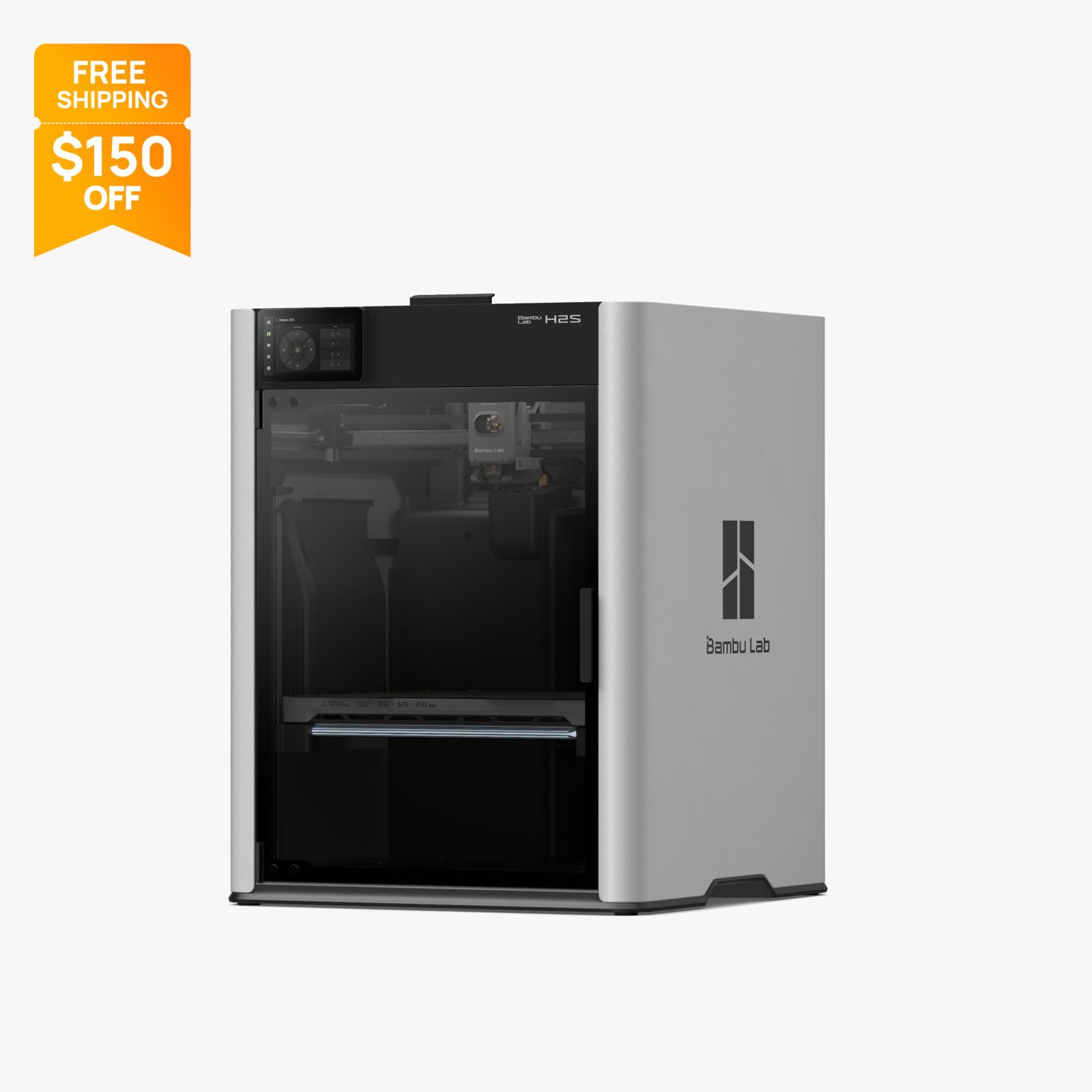
Bambu Lab A1 vs P1S: The $60 Black Friday Question
Black Friday 2026 puts the Bambu Lab A1 Combo and P1S Combo about $60 apart. We compare enclosure, colors, speed, and ABS support to call the winner.
By the Ask Versa AI Editorial Team. Ask Versa AI content is AI-assisted and editorially reviewed before publishing; specs and review sentiment are pulled live from Amazon.
Two Combos, Sixty Dollars Apart
Black Friday 2026 has pushed Bambu Lab's two most popular printers into the same price neighborhood, and the usual advice goes out the window when that happens. The A1 Combo, the open bed slinger bundled with the four-color AMS Lite, is showing up at roughly $419 or under in this week's bundles, against about $259 for the bare printer. The P1S Combo lists at $549, but Amazon's official Bambu store is running it at $479 through the sale, a price both 9to5toys and Mashable flagged in their October and November deal coverage as the lowest on record for that machine.
Part of why the P1S discount runs this deep is generational. Bambu refreshed its enclosed line with the P2S in 2025, so the P1S is the outgoing model, and clearance pricing on it is the closest thing to a sure bet this hobby offers. The A1, by contrast, is still the current full-size machine in Bambu's entry tier. You are not choosing between an old printer and a new one here. You are choosing between two frames.
And the frames are most of the comparison, because nearly everything else is shared. Same 256 x 256 x 256 mm build volume. Same 500 mm/s ceiling, same 300°C hotend, same 0.4 mm nozzle, same automatic bed leveling, vibration compensation, and pressure advance, same Bambu Studio slicer and MakerWorld pipeline. What differs: one printer is enclosed and one is open, one doubles the acceleration, and the two take different color systems. Settle those three and the sixty dollars picks itself.
Same Bed, Different Machine
| Feature | Bambu Lab A1 | Bambu Lab P1S |
|---|---|---|
| Motion system | Open bed slinger (Cartesian) | Enclosed CoreXY |
| Build volume | 256 x 256 x 256 mm | 256 x 256 x 256 mm |
| Max print speed | 500 mm/s | 500 mm/s |
| Max acceleration | 10,000 mm/s² | 20,000 mm/s² |
| Max hotend temp | 300°C | 300°C |
| Chamber | None, open frame | Fully enclosed |
| Sweet-spot materials | PLA, PETG, TPU | PLA, PETG, TPU, plus ABS and ASA |
| Multi-color system | AMS Lite, up to 4 colors | AMS, stackable to 16 colors |
| Nozzle | 0.4 mm standard | 0.4 mm standard |
| Calibration | Auto leveling, vibration compensation, pressure advance | Auto leveling, vibration compensation, pressure advance |
| Slicer and ecosystem | Bambu Studio, MakerWorld | Bambu Studio, MakerWorld |
| Typical pricing | ~$259 bare, Combo bundles ~$419 and under | ~$349 bare, Combo $549 list, $479 on sale |
Two rows deserve a closer read. The build volume row is a tie, and that is quietly remarkable: Bambu did not shrink the bed on its cheaper machine, so plate capacity decides nothing in this pairing. The hotend row is also a tie at 300°C, which matters more than people assume. ABS does not fail on the A1 because the hotend is too cold. It fails because there is no chamber holding warm, still air around the part as it prints. The enclosure row is the materials row, and nothing else in the table can say that.
What the Open Frame Trades Away
PLA prints beautifully on an open frame, PETG behaves with a dry spool and a bit of glue, and TPU is squarely in the A1's lane. The trouble starts with ABS and ASA. Both filaments shrink as they cool, and a draft across an open bed is enough to lift the corners on anything bigger than a small bracket. The P1S's chamber keeps the part cooling slowly and evenly, which is exactly what those materials demand, and its hotend is no hotter than the A1's. The box does the work.
The chamber earns its keep in smaller ways too. It muffles the steppers and part-cooling fans, so an overnight print in a shared room is less of an event. It keeps dust and pet hair off a part that will run for twelve hours. And warm air stays around the print instead of your workspace, which steadies results on long jobs in a cold garage. For unattended multi-hour prints, still air is a feature.
The open frame gives one thing back, and beginners should weigh it. Watching the first layer go down is the single fastest way to learn why prints fail, because nearly every failure announces itself in those first ninety seconds. The A1 lets you see it with nothing between you and the nozzle. The P1S hides it behind a smoked door until the print finishes or the camera tells you otherwise. If your real debate is enclosed-versus-enclosed at this price rather than open-versus-enclosed, our Creality K1C vs Bambu Lab P1S comparison covers that fight instead.
Four Colors or Sixteen
The A1 pairs with the AMS Lite: four spools, and that is the ceiling, because the Lite cannot be chained into more. The P1S runs the full AMS, and AMS units stack, so a committed color shop can drive up to sixteen filaments through one print. That is the difference between two-tone functional parts and full painted-look miniatures on demand.
Both systems pay the same tax. A single nozzle changing colors flushes the old filament out as purge waste, so a colorful print eats more material than the model contains. The purge math, including when multicolor stops paying for itself, is laid out in our multi-color AMS worth-it breakdown. The short version: two or three colors per print is cheap, eight is a filament subscription.
One buying note for this week specifically. The Black Friday discounts land on the Combos, not the bare machines, so if color is anywhere in your plans, the bundle is the cheaper door on either printer. Deciding you want color later means paying full price for the AMS hardware, and on the A1, four spools is all you will ever get.
The Acceleration Row, Honestly
Both printers quote a 500 mm/s ceiling, and neither will hold it on a real part you would want to keep. The row that differs is acceleration: 10,000 mm/s² on the A1 against 20,000 mm/s² on the P1S. The number doubles because the P1S's CoreXY gantry moves a toolhead while the bed only drops in Z, while the A1 swings the entire build plate back and forth on Y. Less moving mass accelerates harder.
In practice this shows up as crisper small features and less ringing on tall parts on the P1S, and as nothing at all on flat plates of trinkets. It is a real difference and a small one. Nobody should pay sixty dollars for this row. Pay it for the chamber, or keep it.
The Black Friday Math
Line the prices up and watch the gap move. Bare against bare, the spread is about $90, with the A1 near $259 and the P1S near $349. Against list, the Combo gap is $150, roughly $399 for the A1 with its AMS Lite against $549 for the P1S with its AMS. This week's sale compresses that to around $60: A1 Combo bundles at $419 or under, P1S Combo at $479. Both are live on Amazon right now, the A1 Combo and the P1S Combo.
Sale arithmetic rewards the wrong instinct here, because the flashier percentage-off belongs to the P1S. Percentage thinking is how people end up paying sixty dollars for a chamber they never open a spool of ABS for, and how others save sixty dollars and spend a year wishing they had one. The gap is small enough now that capability should decide it, not the discount column. Treat all of these as the shape of the deal rather than a quote; sale-week prices move and bundles shift.
Our Pick
For most buyers this week, buy the A1 Combo. PLA and PETG cover the overwhelming majority of what hobby printers print, four colors covers keychains, logos, and two-tone functional parts, and the open frame teaches you the hobby faster because you can see every first layer. The $60 you keep is two or three spools of good filament. For a first printer the case is even stronger, and it is the same reasoning behind our best 3D printer for beginners pick. If you already know color means nothing to you, the calculus changes again and the Bambu A1 vs FlashForge Adventurer 5M matchup becomes the relevant one, since a CoreXY frame for less money is its own argument.
Spend the extra sixty the day any of these is true: you want ABS or ASA parts, for functional or outdoor use. You want more than four colors in a single print. Or the printer will live somewhere a bed cannot stay clean and still, a workshop, a garage, a house with cats. The P1S at $479 is the cheapest enclosed Bambu ticket, and it undercuts its own successor by a comfortable margin. For the full current field at every tier, the 3D printer buying guide ranks where each of these sits.
Frequently Asked Questions
Can the Bambu Lab A1 print ABS or ASA?
The 300°C hotend reaches the right temperatures, but the A1 has no chamber, so ABS and ASA parts cool unevenly and lift at the corners. Small brackets sometimes survive with a brim and glue; regular functional ABS work is a P1S job. Bambu positions the A1 for PLA, PETG, and TPU, and that framing matches reality.
Can I start with the AMS Lite on the A1 and upgrade to the full AMS later?
No. The A1 works with the AMS Lite only, and the Lite tops out at four spools with no chaining. The full AMS belongs to Bambu's enclosed lines, so if you can foresee wanting more than four colors in a print, buy the P1S Combo now rather than banking on an upgrade path that does not exist.
Is the P1S worth the extra $60 over the A1 Combo at Black Friday pricing?
If ABS, ASA, or five-plus-color prints are in your future, yes, and without much deliberation. For a PLA-and-PETG hobbyist, no: the bed, the speed class, the hotend, and the slicer are identical, and sixty dollars buys a lot of filament.
Which one should a complete beginner buy?
The A1. Calibration is equally automatic on both, but the open frame lets a newcomer watch the first layer, which is where almost every failed print shows itself. The P1S is beginner-friendly too; it is just worse at teaching.
Are these the lowest prices these printers see?
The $479 P1S Combo was reported by 9to5toys and Mashable in October and November 2026 as the lowest price on record for that bundle, and clearance pressure from the P2S keeps it there. Bambu discounts recur through the year, but buyers holding out for a meaningfully lower chamber price have been waiting a long time.
Deal windows reward people who already know what they want. Ask Versa AI takes the two Amazon links you are weighing, runs both machines through the spec pages and thousands of owner reviews, and comes back with a scored verdict and who each one suits, so a sixty-dollar call takes a minute instead of the weekend.
Shop smarter with Ask Versa AI
Get occasional product-comparison tips and new features as they ship. No spam.