Best Portable Power Stations 2026: A Value Pick per Tier
Portable power stations are price-band products, and the value story changes at each tier. We pick the model that makes sense from $400 to $1,000-plus.
By the Ask Versa AI Editorial Team. Ask Versa AI content is AI-assisted and editorially reviewed before publishing; specs and review sentiment are pulled live from Amazon.
The Whole Market Is Four Price Tiers
Stop reading "best power station" lists and the market sorts itself into four bands, and each band has a different value story. Below roughly $500 you can still get a real 1kWh station. From about $500 to $800 you are paying for faster charging, more ports, and a growth path. Around $1,000 the 2kWh units start, and past that you are buying capacity you will probably not use.
The mistake most buyers make is shopping within one band and ignoring the cliffs between them. A 1kWh unit on sale at $399 beats a 2kWh unit at $800 for most households, because most households never pull more than a few hundred watts. This guide maps the four tiers, names the one unit to buy in each, and flags the point where paying more stops helping.
Prices below are street ranges we have seen in 2026, not list prices. Power station pricing swings hard around sales, so treat every figure as a "wait for a deal" signal rather than a fixed number.
Tier 1: Under $500, the Real 1kWh Value Zone
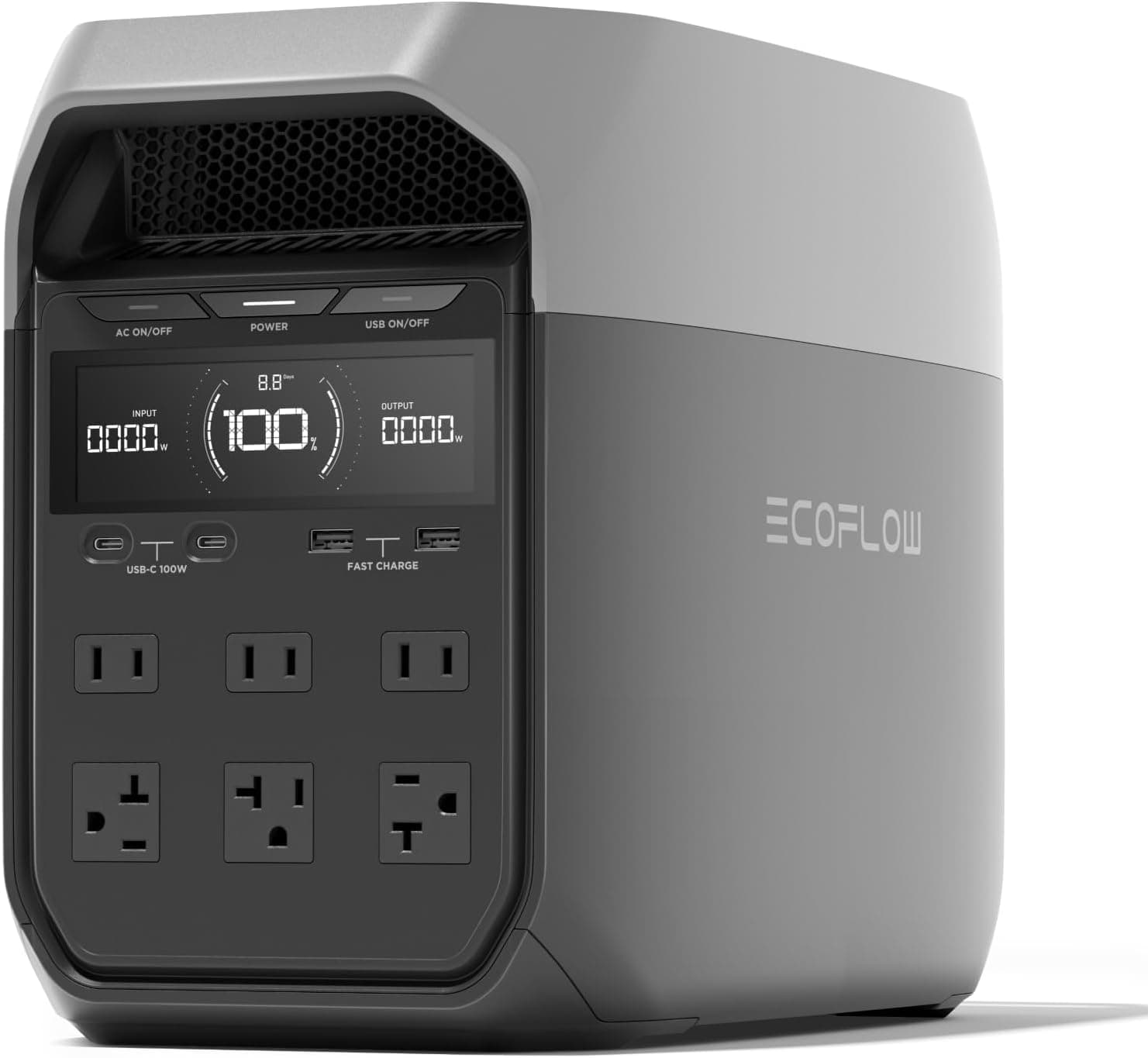
Our pick: EcoFlow Delta 3 (~$399-699)
The Delta 3 is the answer to the most common power-station question: "I want a 1kWh station, what should I pay?" We have seen it at $399 at Walmart, which is a remarkable price for 1024Wh, 1800W output, LiFePO4 chemistry, and a modern platform that expands later. It charges 0-100% in about an hour.
The trade-offs are honest. Output is 1800W continuous (2200W with X-Boost for resistive heating loads only, 3600W surge for motor starts), which covers fridges, CPAP, laptops, TVs, and most tools. It is not a 2600W brute like the DJI unit above it. But for the typical buyer, the Delta 3 at this price is the value sweet spot of the entire category.
The capacity alternative: Bluetti AC180 (~$449-549)
If you care more about runtime than weight, the AC180 holds 1152Wh against the Delta 3's 1024Wh, about 12% more battery for similar money. It also has a richer port panel, including a wireless charging pad. The catch is that it weighs 35.3 lb, which is more than 11 lb heavier than the Delta 3, and it cannot expand capacity later. See the EcoFlow Delta 3 vs Bluetti AC180 comparison for the full breakdown.
Who should not shop this tier: anyone planning home backup during long outages, or anyone who already owns power tools and knows they will stack heavy loads. Both groups want Tier 3.
Tier 2: $500-800, the Fast-Charging Sweet Spot
Our pick: EcoFlow Delta 3 Plus (~$689-799)
This is where the category stops being a battery and starts being a home system. The Delta 3 Plus keeps the 1024Wh base but adds 13 ports, six AC outlets, a 0-100% charge in 56 minutes on 1500W input, and a true UPS that switches over in under 10ms. It is also expandable to 5kWh with extra batteries, which is the single feature that lets you start at 1kWh and grow without buying a new unit.
For most people who land here, the expansion option is the real purchase. You buy the 1kWh now, add a battery before a known outage, and never throw the original away. That is rare in this category.
The faster-charger alternative: Anker SOLIX C1000 Gen 2 (~$499-799)
Anker's Gen 2 refills fully in 49 minutes, which it markets as a Guinness World Record, spreads power across 10 ports, and behaves like a small UPS for a router or NAS during a blip. Its 2000W output (3000W surge) handles more continuous draw than the Delta 3 Plus's 1800W. The trade-off is a closed system: it does not expand like the EcoFlow line. Pick it when fast full recharges and port count matter more than growing later. The DJI Power 1000 V2 vs Anker SOLIX C1000 Gen 2 comparison covers the Anker in detail.
The spec-sheet king at this price: DJI Power 1000 V2 (~$399-499)
The DJI punches above its price band, which is why it leaks into this section. It is rated at 2600W continuous AC output, the highest in the 1kWh class, and charges 0-80% in about 37 minutes. At $399-499 on sale, it is hard to beat on watts-per-dollar. What it lacks is a growth path, no expansion, and no UPS priority, and its standout SDC port is aimed at DJI drone owners. See it against the Delta 3 Plus in our DJI Power 1000 V2 vs EcoFlow Delta 3 Plus comparison. If you need to run a 1500W heater, kettle, or stack of tools, this is the one.
Who should not shop this tier: buyers who just need a cheap 1kWh unit, they belong in Tier 1. This tier is for people who want charging speed, ports, or expansion, and each of the three picks above trades those differently.
Tier 3: Around $1,000, the 2kWh Backup Class
Our pick: Anker SOLIX C2000 Gen 2 (~$799)
The C2000 Gen 2 packs 2048Wh, pushes 2400W rated and 4000W peak, and refills fully in 58 minutes. It weighs 41.7 lb, which is heavy but not silly, and it expands to 4096Wh. At roughly $799 it undercuts its main rival, the Bluetti Elite 200 V2, by several hundred dollars while offering expansion that the Bluetti lacks.
Against the Elite 200 V2, the C2000 Gen 2 is the better value for almost everyone. The Bluetti counters with 6000+ charge cycles to 80% against the Anker's 4000, and 1000W solar input against 800W, which matters for off-grid solar-first setups. If you are RV boondocking and solar is your primary input, the Bluetti's solar ceiling is worth the extra money. Otherwise the Anker wins on price, weight, and expansion. Our Anker SOLIX C2000 vs Bluetti Elite 200 V2 comparison walks through the whole trade.
Tier 4: Over $1,000, Where Value Ends
This is the cliff. Units like the Bluetti Elite 200 V2 (around $1,099, down from a $1,999 MSRP) and EcoFlow's 3kWh-plus line deliver real capacity, but they cross into diminishing returns for the standard buyer. A 2kWh unit already runs a fridge overnight and a CPAP for days. Doubling to 4kWh doubles the weight, roughly doubles the price, and buys headroom most people touch once or twice a year.
The one reason to be here: whole-home backup where a fridge, a well pump, and several circuits must run for days. That is a different product decision, closer to a home battery than a portable station. If that is your case, buy the largest expandable 2kWh unit you can start with, and add batteries as you learn your real draw. Do not buy a 5kWh behemoth on day one.
The Picks at a Glance
| Tier | Model | Capacity | Output | Recharge | Price range | Best for |
|---|---|---|---|---|---|---|
| Under $500 | EcoFlow Delta 3 | 1024Wh | 1800W | ~1h to 100% | ~$399-699 | First station, value |
| $500-800 | EcoFlow Delta 3 Plus | 1024Wh | 1800W (3600W surge) | ~56min | ~$689-799 | Growable home system |
| $500-800 | Anker SOLIX C1000 Gen 2 | 1024Wh | 2000W (3000W surge) | 49min full | ~$499-799 | Fast charge + 10 ports |
| $500-800 | DJI Power 1000 V2 | 1024Wh | 2600W continuous | 0-80% in ~37min | ~$399-499 | High-output loads |
| ~$800 | Anker SOLIX C2000 Gen 2 | 2048Wh | 2400W (4000W peak) | 58min | ~$799 | Home backup, expandable |
| $1,000+ | Bluetti Elite 200 V2 | 2073.6Wh | 2600W (3900W peak) | ~1.5h | ~$1,099 | Solar-first off-grid |
Two Rules That Make Every Tier Make Sense
Rule one: match the tank to a real load, not a fear. Write down the three or four things you will actually plug in and add their watts. A phone, laptop, CPAP, and a TV draw well under 500W together. A fridge adds surge headroom. If your honest list stays under 600W, the Delta 3 at $399 is a smarter buy than a $1,099 2kWh unit.
Rule two: expansion beats capacity you do not need yet. Between two units, one with a lower starting capacity that accepts extra batteries and one with more capacity that cannot expand, take the expandable one. You can add battery when a real need shows up. A closed 2kWh unit that you never use a second time is the most expensive option in the category.
For a fuller primer on sizing, chemistry, and the watts-versus-watt-hours confusion, the portable power station buying guide walks through the numbers. To see any two of these models argued against each other, the Jackery Explorer 1000 v2 vs Anker SOLIX C1000, EcoFlow Delta 2 vs Anker SOLIX C1000, and Bluetti AC180 vs Anker SOLIX C1000 comparison pages run the live analysis.
Frequently Asked Questions
What is the best value portable power station in 2026?
At the sub-$500 tier, the EcoFlow Delta 3 is the value pick, around $399-699 for 1024Wh, 1800W output, and an expandable platform. The Bluetti AC180 offers more capacity (1152Wh) for similar money if you do not mind the extra 11 lb.
Should I buy a 1kWh or 2kWh power station?
A 1kWh unit covers a phone, laptop, CPAP, TV, and a fridge through an outage for most households. Go to 2kWh when you need to run a fridge plus several other circuits for days, or when you know you will stack heavy loads. If you are not sure, buy the expandable 1kWh unit and add battery later.
Do portable power stations come with solar panels?
Almost never. Panels are sold separately, and you should budget $150-400 for a usable panel if off-grid charging matters. Check the station's maximum solar input before buying panels, since the input ceiling varies widely (600W to 1000W+ depending on the model).
Why is the DJI Power 1000 V2 cheaper than other 1kWh stations?
It is not always. On sale it lands at $399-499 with 2600W continuous output, which is class-leading for the price. The trade-offs are a closed system with no expansion and a port layout aimed at DJI drone owners. It wins on raw watts-per-dollar and loses on long-term growth.
When should I spend over $1,000 on a power station?
Only for whole-home backup, where a fridge, a pump, and multiple circuits must run for days on end. Below that threshold, a 2kWh unit at $800 or an expandable 1kWh unit covers the same real-world loads for less.
Before You Buy
Every unit above has a specific trade that the numbers do not show: the fan drone under load, how the app behaves, whether the UPS switchover actually saves your router. Paste two shortlisted models into Ask Versa AI and you get the owner-experience verdict that the spec sheets skip.
Shop smarter with Ask Versa AI
Get occasional product-comparison tips and new features as they ship. No spam.