A 10,000-Watt 'Solar Generator' Is Two Different Products
Search 'solar generator 10000 watts' and you get a gas generator, a home battery, and a DIY kit. The 240V rule decides which you actually need.
By the Ask Versa AI Editorial Team. Ask Versa AI content is AI-assisted and editorially reviewed before publishing; specs and review sentiment are pulled live from Amazon.
The Search Term Hides a Category Confusion
Type "solar generator 10000 watts" into Google and you get three unrelated things competing for the same query: a 10,000-watt gas generator, a whole-home lithium battery system like the EcoFlow Delta Pro Ultra, and a DIY solar kit you wire yourself. They share a watt figure and almost nothing else. That is why the SERP is so messy, and why you cannot trust the "best 10000 watt solar generator" roundups that mix them.
The honest first question is which of these you are actually shopping for. A gas generator is a different purchase from a battery system, and a battery system is a different purchase from a solar panel kit you install on a wall. This guide sorts them out and gives you the number that decides which one is right, the 240V question.
What "10000 Watts" Actually Means on a Spec Sheet
A "10,000-watt solar generator" usually means the inverter can deliver up to 10,000 watts of AC output. That figure has three catches. It is a peak rating more often than a continuous one. It only matters if your loads actually need that much. And in a standard US home, a single 120V circuit physically cannot carry that load anyway.
The physics is not optional. A 15-amp 120V circuit caps out around 1,800 watts, and a 20-amp circuit around 2,400 watts. So a unit that truly outputs 10,000 watts must provide 120V/240V split-phase power, the kind a home's main panel uses. If a "10kW solar generator" only lists 120V outlets, it cannot actually run a 10kW load in a house, and the marketing is doing the work.
That is why the electrician community keeps hammering the same two points. In a thread on r/electricians about 10,000-watt generators, the repeated advice is that you must prevent backfeeding the utility line with an interlock plate or a transfer switch, and that the generator "must have 240v output" or it is useless for whole-home use. If a product cannot plug into your panel through a proper interlock, it is not a whole-home solution no matter what the watt sticker says.
The Two Product Classes That Actually Exist
Whole-home battery systems
These are the only "solar generators" that can genuinely power a house, because they output 120V/240V split-phase. They are large, heavy, and expensive, and they behave more like a small home battery than a portable station.
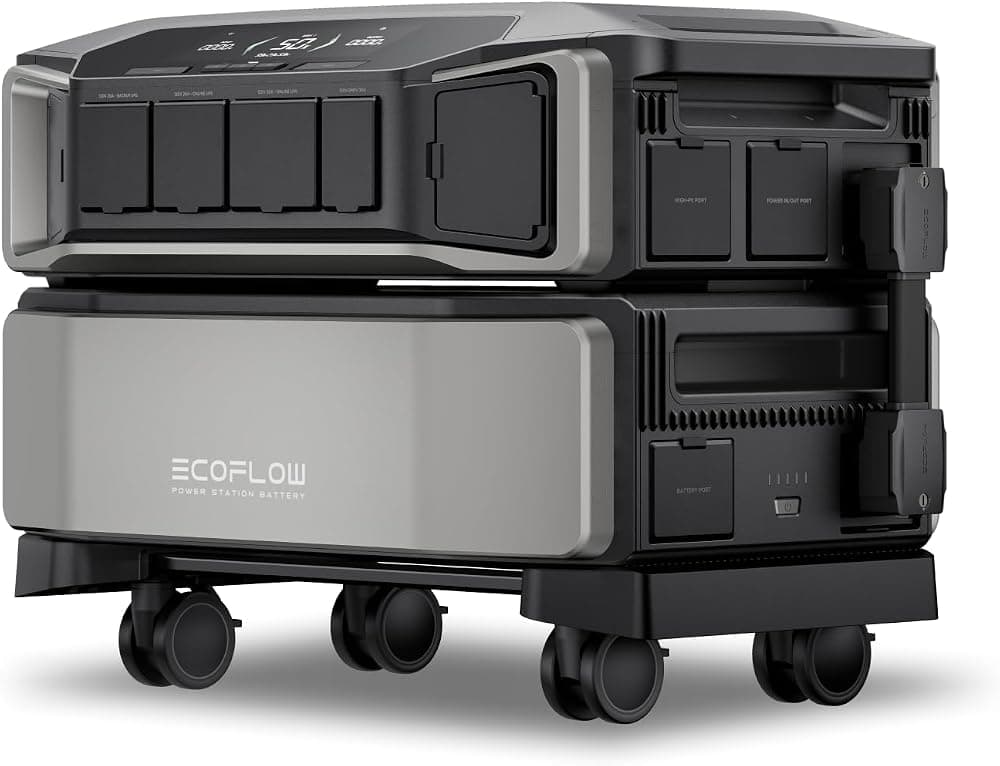
The EcoFlow Delta Pro Ultra is the flagship example. The base unit holds 6,144Wh, outputs up to 7,200W on 120/240V, recharges fully in about two hours, and expands to 90kWh with extra batteries, per EcoFlow's product page. Street prices swing from around $4,100 to $6,300 depending on bundle and sale, and owners on r/Ecoflow_community report package deals on the two-battery, one-inverter configuration anywhere from $5,799 to $6,999 depending on channel. The same thread has a fair warning: for a real house, you will often end up wanting two inverter heads, and you cannot share solar panels between them.
The Anker SOLIX F3800 is the other name in this class, at 3,840Wh and 6,000W output with 120V/240V support. It has been discounted hard, and live Amazon listings show it as low as about $2,000 during sale windows against a typical $4,000-plus list price. The catch is that its 240V capability depends on buying a second F3800 and linking them, which is a significant hidden cost to budget for.
The Nature's Generator MyGrid 10K sells at $7,699.99 for 10,496Wh and 10,000W continuous output on 120V/240V, per the MyGrid 10K product listing. It is genuinely plug-and-play, expandable, and dual-voltage, which makes it the most literal answer to the "10000 watt solar generator" query on the market. It is also a $7,700 purchase, which brings the cost question into sharp focus.
Expandable home backup stations
A step below the split-phase systems, these are the big 2kWh-plus portable stations with expansion options. They will not run a whole house, but they will run a fridge, a freezer, a well pump's control, and a stack of circuits for days. They only output 120V, which is fine for 95% of outage essentials.
This is where the value math from the rest of the market applies. The EcoFlow Delta Pro 3 at 4,096Wh with two 400W panels has been on sale around $3,499, and the Jackery HomePower 3600 Plus at 3,584Wh with two 200W panels around $2,399. Neither runs a whole house, but both cover a critical-load panel comfortably.
DIY solar kits
The third thing in the SERP is a real solar install, not a generator. A 10kW kit from SunGoldPower runs about $9,410 on sale from a $12,547 list and includes panels, a 48V lithium battery bank, and a split-phase inverter producing roughly 20kWh per day in good sun, per the SunGoldPower 10kW kit listing. This is a full off-grid or whole-home solar system, not a portable product, and it is the domain of r/SolarDIY.
The DIY crowd is worth listening to here because they consistently point out the cost gap. In a widely-shared r/SolarDIY thread on 10kW builds, the takeaway is that an EG4-based system assembled from standard components undercuts the portable brands on price and is far easier to repair, because every part follows a standard and can be replaced. One commenter put it plainly: "God knows what happens if a DPU inverter head dies five years from now." When a brand goes out of its wheelhouse, the standardized DIY ecosystem usually wins on longevity.
The Load Math That Decides Your Size
Before any price discussion, do the arithmetic. Add the wattage of everything you want to run at once, then multiply by hours to get watt-hours per day. A house with a fridge (about 150W average), a freezer, lights, a router, and a TV sits well under 1,000W continuous and perhaps 5-8kWh per day. That is a Delta Pro-class unit, not a 10kW one.
A whole-home 10kW system makes sense in exactly two situations. One, you need 240V for well pumps, electric water heaters, or a heat pump. Two, you want to run several circuits for days on end without rationing. If neither is true, buying 10,000 watts of inverter is paying for a number you will never reach, the same mistake the portable power station market warns about at a smaller scale.
The r/prepping and r/Electricity communities make the same point in their outage threads: measure your actual load with a watt meter before you buy anything. A dedicated backup just for the fridge on a 2kWh station, as one r/prepping owner describes, beats a giant system you cannot fully use.
The Federal Tax Credit Changes the Math
The 30% federal solar tax credit applies to eligible battery systems, and it is the difference between a bad and a good price. EcoFlow advertises the credit on its own product pages for the Delta Pro 3 and Delta Pro Ultra. If you pay $4,000 for a qualifying system, the credit roughly turns it into a $2,800 purchase. A $7,700 MyGrid becomes about $5,400.
That does not rescue a system you did not need in the first place, but it makes the genuinely-needed whole-home purchase more palatable than the sticker suggests. Check whether the specific model and configuration qualify before you assume the discount.
Who Should Not Buy Any of This
If your actual need is running a fridge, a phone, and a CPAP through an outage, you belong in the $400-800 portable station tier, not the $4,000-plus split-phase tier. The best portable power stations guide covers that market, and the math is the same: match the tank to a real load.
If you want 240V but your loads are modest, a 2kWh expandable station plus a small inverter for the rare 240V appliance usually covers you for far less. If you want solar independence long-term and can tolerate the learning curve, the DIY route is cheaper and more repairable. Buy the all-in-one "10kW solar generator" only when you have a confirmed 240V or whole-home load that a portable station cannot carry.
Frequently Asked Questions
Can a 10,000-watt solar generator power a whole house?
Only if it outputs 120V/240V split-phase and connects to your panel through an interlock or transfer switch. Most portable "10kW" stations are 120V-only and physically cannot deliver 10,000 watts to a home panel. True whole-home systems are the EcoFlow Delta Pro Ultra, Anker SOLIX F3800, and Nature's Generator MyGrid 10K class.
What is the difference between watts and watt-hours?
Watts measure instantaneous power draw, like how much a fridge pulls at one moment. Watt-hours measure stored energy, like how long that fridge can run. A 10,000W inverter is useless if the battery only holds a few hundred watt-hours, because it drains in minutes. Capacity in watt-hours, not inverter output, is what determines runtime.
Is a 10kW solar generator cheaper than a gas generator?
No, on sticker price. A comparable 10kW gas generator costs a fraction of a battery system. The solar battery wins on operating cost over years, no fuel, no noise, and no fumes, but you pay that premium up front, and the federal tax credit only narrows the gap.
How much does a whole-home solar generator cost in 2026?
Roughly $4,000 to $8,000 for the battery system alone, before panels and installation. The EcoFlow Delta Pro Ultra starts around $4,100 on sale, and the Nature's Generator MyGrid 10K is $7,700. Panels, a transfer switch, and installation add more, and the 30% federal credit offsets part of it.
Do I need a permit to connect a solar generator to my house?
Almost certainly yes if you wire it into your panel. r/electricians threads stress that a transfer switch or interlock is required to prevent backfeeding the utility line, and local codes differ. Get an electrician involved for any hardwired connection; a plug-and-play system you just plug outlets into avoids most of this.
Before You Commit
The difference between the three products in this SERP is larger than any spec sheet suggests: whether it is a fuel tank, a battery you plug in, or a wall of panels you install. If you are deciding between two battery systems, shortlist the models, then paste them into Versa AI to compare the owner-experience verdicts that the wattage numbers never show.
Shop smarter with Ask Versa AI
Get occasional product-comparison tips and new features as they ship. No spam.