What Solar Generators Actually Cost in 2026, by Real Prices
We scraped 30 live 'solar generator' listings by capacity. Price per watt-hour rises as units get bigger; here is what each tier buys.
By the Ask Versa AI Editorial Team. Ask Versa AI content is AI-assisted and editorially reviewed before publishing; specs and review sentiment are pulled live from Amazon.
The Price Story Is Not Where You Expect It
Ask what a solar generator costs and you get a useless range: "$300 to $25,000." The honest answer requires breaking the market into tiers, and when you do, one finding surprises everyone: bigger units cost more per watt-hour, not less. Economy of scale works for solar panels on a roof, but it works backward in portable generators.
We scraped 30 live "solar generator" listings on Amazon and sorted them into capacity bands. The medians are clear. Units under 500Wh ran about $190 at the median, at $0.54 per watt-hour. The 500-1,500Wh class ran about $710 at the median, at $0.71 per watt-hour. And the 3,000Wh-plus flagships ran about $3,499 at the median, at $0.87 per watt-hour.
So the biggest units are the least efficient per watt stored. What you buy with the premium is the ability to run a whole fridge or a house's circuits, not a better rate on electricity. That single fact reframes every "which size" question in the category.
The Under-$300 Tier: A Real Battery for Under $200
This tier is defined by the white-label sellers that own Amazon's volume. The MARBERO 111Wh with a 30W panel sells for about $100 with nearly 9,000 reviews, and the MARBERO 237Wh with a panel runs about $160. The Takki 120W station sits at about $108 with 2,595 reviews. These are the products that prove the entry market is not a gimmick: thousands of people buy a couple hundred watt-hours for under $200.
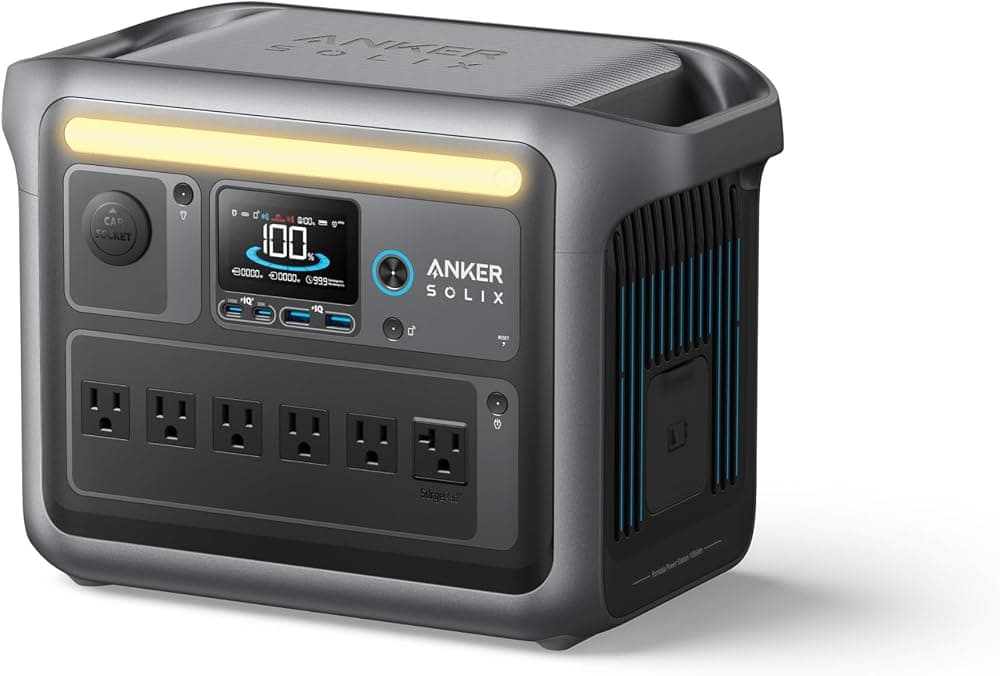
At the brand-name end, the Jackery Explorer 300 (292Wh, about $259) has over 11,000 reviews and a 4.6 average, and the Bluetti Elite 30 V2 (288Wh, about $239) is CNET's pick for the most affordable station. The Anker SOLIX C300 (288Wh with a 60W panel, about $330) pushes the tier's ceiling on build quality.
What $100-300 buys: a phone, a tablet, a CPAP for a night, lights, and a laptop charge. What it does not buy: a fridge. The r/preppers advice on budget solar matches the data: brands like Anker and Bluetti on sale are the reliable entry point, and "solar panels are way cheap now, like 100W for $50," if you are willing to assemble a system yourself.
The $400-500 Tier: The Value Sweet Spot
The best price-to-capability ratio in the entire market lives around $430-500, and it is not close. The Anker SOLIX C1000 (1,056Wh, about $430) has a 4.7 average across 1,825 reviews. The EcoFlow Delta 2 (1,024Wh, about $430-499) has over 5,200 reviews and a 4.7 average, making it the most-bought 1kWh unit on Amazon. The Bluetti AC180 (1,152Wh, about $449) and Jackery Explorer 1000 v2 (1,070Wh, about $447) round out a quartet where every name is under $500.
At $0.40-0.45 per watt-hour, these units beat the larger class on efficiency while still running a fridge, a CPAP, a TV, and a stack of electronics through a long outage. This is the tier the portable power station buying guide calls the real value zone, and the numbers back it. For most buyers, a 1kWh unit at $450 is the entire answer.
The trade-offs at this price are real but minor: slower recharge than the flagships (roughly 1.5-2 hours versus under an hour), fewer ports, and no 240V split-phase output. If none of those matter, and for most buyers none of them do, this tier is where the money should go.
The $700-1,000 Tier: Solar Bundles and More Ports
At this price you start paying for the panel bundle and faster charging. The Anker SOLIX C1000 Gen 2 with a 100W bifacial panel runs about $710. The Jackery Solar Generator 1000 v2 with a 200W panel runs about $779. The EcoFlow Delta 3 with a 160W panel runs about $829.
The premium buys three things: a panel you would buy separately anyway, faster wall charging (the Gen 2 refills in under an hour), and more ports. The economics only work if you actually value the bundled panel and the fast recharge. If you already own a panel or never plan to solar charge, the $430-500 tier without the bundle is the better deal. The current best-solar-generator coverage makes the same point that bundles swing hard on sale: a common 2026 example drops a $3,699 MSRP bundle to about $1,839 at 50% off.
The $2,000-4,000 Tier: Whole-Home Territory
This is where the per-watt-hour number gets worse, and where the use case gets fundamentally different. The Jackery HomePower 3000 (3,072Wh with two 200W panels) sits around $1,899-2,399. The Jackery HomePower 3600 Plus (3,584Wh with two 200W panels) runs about $2,399. The EcoFlow Delta Pro 3 (4,096Wh with two 400W panels) is about $3,499. The ECO-WORTHY SL7000 stackable system (10,240Wh) tops the scan at about $4,000. The Anker SOLIX F3800 (3,840Wh) has been seen around $2,000 on sale against a $4,000-plus list.
You buy this tier to run a whole fridge, a freezer, and several circuits for days, or to power a cabin. The 30% federal solar tax credit applies to eligible systems, which turns a $3,499 purchase into roughly a $2,449 one, and EcoFlow advertises the credit directly on its product pages. Whole-house systems climb from about $3,500 to $25,000 depending on capacity and installation, per the current cost guides.
The r/prepping guidance for this tier is blunt and correct: to keep a full-size fridge and a small AC running for a day or two you need at least 2kWh of capacity and a high surge rating, and units like the EcoFlow Delta Pro 3 are the sensible picks, per the r/prepping 2026 power station thread. Below that need, the 1kWh tier covers the same essentials for a fifth of the price.
The One Number That Decides Your Tier
Before pricing matters, you need the load math. Add the wattage of the things you will actually run, multiply by hours, and you get your daily watt-hour need. A fridge at about 150W average for 8 hours is 1,200Wh. A phone, laptop, and lights are a few hundred. CPAP is about 400Wh a night. Add your real devices, not the list of everything you own, and pick the tier that covers that number with margin.
If your daily need is under 1,000Wh, the $430-500 tier is the value answer, full stop. If it is 1,500-3,000Wh, you are in bundle or whole-home territory. If you are only charging phones at a campsite, the $190 white-label units are honestly fine, and the brand premium buys durability and support, not capability.
Frequently Asked Questions
How much does a solar generator cost in 2026?
From about $100 for a 111Wh unit with a panel to $4,000-plus for 10kWh whole-home systems. The most-bought sweet spot is the 1kWh class at $430-500, which covers a fridge and electronics through an outage. The 30% federal tax credit applies to eligible systems.
Why do bigger solar generators cost more per watt-hour?
Because you are paying for capability, not efficiency. Scraping 30 live listings showed $0.54 per watt-hour under 500Wh, $0.71 in the 1kWh class, and $0.87 in the 3kWh-plus flagships. The premium buys the ability to run heavy loads, not a better rate on stored power.
Is a $200 solar generator worth it?
For phones, lights, a CPAP for a night, and a laptop, yes. The MARBERO and Takki units in the $100-160 range have thousands of reviews for exactly this use. For a fridge or power tools, no, and you will find out the first time you plug one in.
Do solar generators come with solar panels?
Sometimes, and that is the difference between the $430 and $700 tiers. The $430-500 units are stations only. The $710-830 bundles add a 100-200W panel. Panels are also sold separately, and a 100W panel runs roughly $100-150, which is why the bundles only make sense if you want to solar charge.
What size solar generator do I need for a fridge?
A fridge averages about 150W, so running it for 8 hours needs about 1,200Wh, meaning a 1kWh station is the practical minimum with a higher surge rating for the compressor. This is the threshold where the $430-500 tier earns its place over the sub-$300 units.
The Honest Purchase
Buy the smallest tier that covers your real daily watt-hour need, and put the savings into capacity you might someday use rather than into a flagship you never load. The 1kWh class at $430-500 is the value center of the entire market, and everything above it trades efficiency for whole-home capability. Shortlist two models and run them through Versa AI to see which one's owners actually like living with before you spend.
Shop smarter with Ask Versa AI
Get occasional product-comparison tips and new features as they ship. No spam.