Van Life Power Stations: Recharging, Not Capacity
Van dwellers don't buy power stations by the biggest battery. They buy by recharge method, space and weight the rig can carry, and behavior at 3am.
By the Ask Versa AI Editorial Team. Ask Versa AI content is AI-assisted and editorially reviewed before publishing; specs and review sentiment are pulled live from Amazon.
The Question Nobody Asks First
Every van life power station guide starts with capacity, as if the decision were about how many watt-hours you can afford. The people actually living in vans start somewhere else entirely: how will this thing get recharged, and does it fit the rig.
A van has no wall outlet. Whatever you buy has to be topped up from solar panels, the alternator, a campsite hookup, or a cafe's wall socket, and the speed of that recharge is what decides whether the unit is useful or a paperweight. The r/urbancarliving thread on starting van life puts it bluntly: "The biggest annoyance is recharging." Buy a station you cannot refill and you have bought a very heavy flashlight.
The second question is physical. A van is a tube of limited cubic feet, and a 60-pound 2kWh station eats floor space and cargo weight you planned for something else. Outside, which has a dedicated power station editor, frames the whole category around portability and durability for exactly this reason: the units that survive van life are the ones with weather sealing and drop tolerance, not the ones with the biggest spec sheet.
The Recharge Math Comes First
Work out how you will charge before you work out how big. A 200W portable solar panel in good sun produces roughly 800Wh-1kWh a day, which is why the r/vandwellers crowd running solar pairs a small station with two 100W panels they can position in the sun rather than a giant station they cannot refill. An alternator charger, where supported, can add far more power per driving hour, which is why units with 12V input or a dedicated alternator charging accessory show up so often in van builds.
The r/VanLife community thread on portable power stations spells out the practical version. For phones, a fan, and a projector, 300-500Wh is enough. For a 12V fridge plus daily electronics, you are looking at the 1-2kWh class. And for cooking with electricity or running a kettle, you need 2kWh-plus and a charging source that can keep up, or you will be rationing every day. The worst possible purchase is the biggest unit you can afford with no plan to recharge it, because it becomes a one-time battery you slowly drain.
Match the Unit to the Van
The minimalist rig: 300-500Wh
A person running a laptop, phones, a fan, and lights can live on this tier, and it is the smallest thing worth buying. The Bluetti EB3A (268Wh, LiFePO4) is the pick Practical Motorhome names for a campervan, and the Jackery Explorer 300 (292Wh, about $229) with over 11,000 reviews is the volume brand pick. These weigh around 9-10 pounds, fit under a bench seat, and charge fully in about 90 minutes on AC. The catch is they do not run a 12V fridge for long, which is the line most full-timers cross.
The full-time sweet spot: 1-2kWh
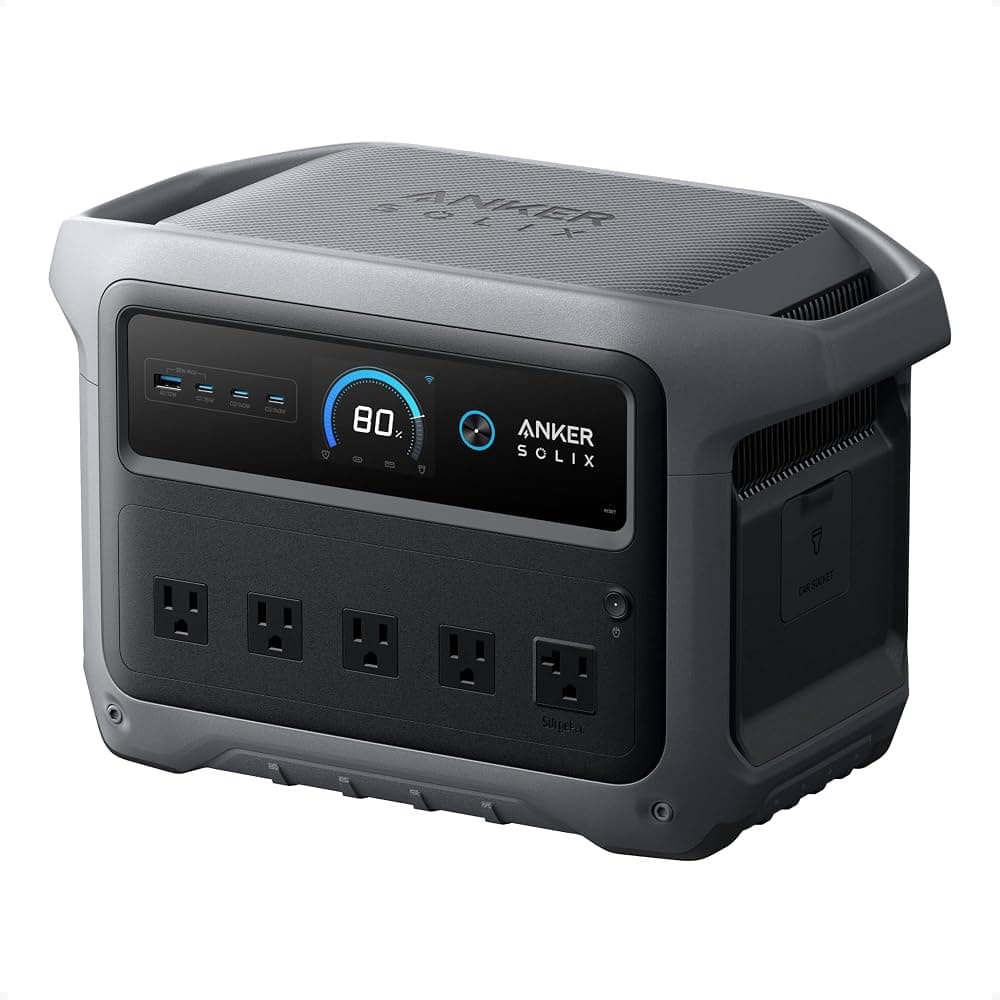
This is where the vandweller community actually lives. The r/VanLife owner thread on living in a van for three months names the Anker Solix C2000 Gen 2 as the unit that handled everything, with the display singled out for making power usage visible. The r/urbancarliving starting-van-life thread lists the serious contenders as the EcoFlow Delta 2 Max, Bluetti AC200MAX, Anker SOLIX F2000, and Jackery Explorer 2000 Pro, all in the 2kWh class. The campervan buying guides flag the fast-charge angle: a unit that hits 80% in about 51 minutes makes the recharge problem far less painful when you do find a plug.
The Anker SOLIX C1000 Gen 2 (1,024Wh) is the OutdoorGearLab pick for the best power station for most people and is the sensible entry to this class, expandable and fast-charging without the 2kWh weight. For a fridge, a laptop, lights, and a fan, the 1kWh tier covers a day-plus with margin, and the 2kWh tier turns that into multiple days.
The heavy user: 2kWh-plus
Running a 12V fridge, a microwave or induction burner, a kettle, and lights needs the 2kWh-plus class, and the r/vandwellers thread on full-time living points to the OUPES Mega 5 as the value pick of the category. The honest math from the community is that this tier is where a portable station stops being a supplement and starts being a mini house system, and at that point you should weigh it against a proper installed build. The Anker SOLIX F2000 and Jackery Explorer 2000 Pro are the brand-name options in this class, and the Goal Zero Yeti 1500 (1,516Wh) is the ecosystem alternative with the longest aftermarket support.
The DIY Question Nobody Avoids
There is a persistent, uncomfortable question on every van forum: should you just build a real electrical system instead of buying a portable station? The r/vandwellers answer is remarkably consistent. A DIY system with a lithium battery, a charge controller, and a 12V distribution panel costs roughly 40% less than an equivalent portable station, and it wires the fridge, lights, and USB straight into the van. For a full-time build, it is the cheaper and more capable route.
The counterargument is also honest. Not everyone is electrically inclined, and a portable station works in any van, can be pulled out and used at a campsite or during a power outage at home, and carries no install risk. The r/vandwellers thread on portable versus traditional systems is the cleanest statement of the trade: if you plan to run a fridge and real electronics, learn basic wiring and build in, and if you want plug-and-play portability, accept paying more for it. Starting with a portable station and adding solar later is a completely fine plan, which the r/VanLife community endorses for anyone overthinking their first setup.
What the Owner Forums Actually Complain About
The recurring complaints in the van subs are not about capacity. They are about noise, heat, and charging quirks. The fan that spools up under load is the #1 pet peeve in a small space, and it is the reason a unit's low-load silence matters more in a van than anywhere else. The heat a big inverter puts off in a confined build is the second. And the third is the slow AC recharge: owners consistently note that a unit which takes six hours to refill becomes a burden, while one that hits 80% in under an hour barely registers as a task.
The r/camping community adds a practical one for anyone planning to cook off a station: do not make coffee with electricity. A French press or percolator uses no power at all, and the r/VanLife owner who runs a hot plate on a station is spending their entire daily solar budget on one cup. Heat is a miserable way to use electricity, and it is the fastest way to drain a van battery.
Frequently Asked Questions
How big of a power station do I need for van life?
For a laptop, phone, fan, and lights, 300-500Wh is enough. For a 12V fridge plus daily electronics, go 1-2kWh. For cooking with electricity, 2kWh-plus. The 1kWh class is the sensible full-time starting point, with the 2kWh tier as the upgrade when a fridge joins the setup.
Can I run a fridge off a power station in a van?
Yes, a 12V fridge draws roughly 30-50W, so a 1kWh station runs one for about a day and a 2kWh unit for two to three. The catch is recharge: if your only source is a 200W solar panel, you are spending most of the day's harvest on the fridge.
Is a portable power station or a DIY build better for a van?
A DIY system is about 40% cheaper and wires the fridge and lights straight in, making it the better long-term choice for full-timers. A portable station costs more, takes up space, and needs recharging as a unit, but it is plug-and-play, removable, and works at home during outages. Start portable and upgrade later is a valid path.
How do I recharge a power station in a van without a hookup?
Solar panels, the alternator via a 12V input or dedicated alternator charger, or occasional AC at a cafe or campsite. A 200W panel produces about 800Wh-1kWh a day in good sun, which is why fast solar input and a 12V charging option matter more than raw capacity.
Will a power station run a heater or AC in a van?
No, and this is the one hard limit the community repeats. Generating heat or cooling with electricity requires grid-scale power. An r/urbancarliving thread says it plainly: "You will not be able to run an electric heater from a power station." Heat and AC are the reasons van builds use propane or diesel, not batteries.
The Verdict for Van Life
Buy the smallest station that covers your real daily draw, optimize the recharge path first, and do not pretend a portable battery can run heating or a serious kitchen. The 1kWh class with fast AC charging and a solar input is the right starting point for most builds, and the 2kWh class earns its weight the day a 12V fridge joins the rig. When you have two candidates, let Versa AI compare the owner reviews, because the 3am fan noise and the charging behavior are exactly what the spec sheet hides.
Shop smarter with Ask Versa AI
Get occasional product-comparison tips and new features as they ship. No spam.