The Tailgate Power Station Is Smaller Than You Think
The right power station for a tailgate is smaller than you think. We sized tailgate loads (cooler fridges, speakers, phones) against the stations that fit them.
By the Ask Versa AI Editorial Team. Ask Versa AI content is AI-assisted and editorially reviewed before publishing; specs and review sentiment are pulled live from Amazon.
Start With the TV, Not the Spec Sheet
Every tailgate power station roundup opens with flagships. Then you read about 2,000Wh units and 2,000W inverters and wonder whether your cooler is about to melt. Walk the actual math instead, because the numbers land somewhere else entirely.
A 32-inch LED TV pulls about 50W. A soundbar or a pair of bluetooth speakers draws 30-60W. A phone charges at under 10W. LED string lights are single digits. Add it up for a modest tailgate and you are at maybe 120W continuous, which is less than a MacBook charger. The r/Generator community has been making this exact point for years. In a thread about powering a tailgate TV and game console, the top advice is to buy a watt meter, measure the real draw, and remember that a TV's actual consumption "is guaranteed to be less than the maximum rating on the power brick." One commenter ran the example: an N64 at 20W plus a 120W TV fits comfortably on a 200W inverter.
That changes the whole buying decision. You do not need a 1kWh powerhouse to run a TV for four hours. You need enough watt-hours for the runtime you want, and the threshold is far lower than the marketing suggests.
The Math, Worked Out
Take a real setup: a 50W TV, 40W of speakers, 10W of lights, and two phones. That is roughly 105W continuous.
If you only ever watch two or three quarters with the lights off, a 300-500Wh unit is the honest size. Where the 1kWh tier earns its money is not the TV. It is the tailgates where somebody brings a small electric air fryer or a portable induction burner, both of which draw 1,000-1,500W and need a station with real inverter output. If your crew cooks with electricity, size for that. If you cook on a propane grill like most lots, size for the TV.
The r/Generator thread on tailgate TVs sums up the sensible default: "Get a Jackery or Bluetti power station instead. A 32-inch LED TV will likely use around 50W, so for 3-4 hours you only need a couple hundred watt-hours." The same calculation shows up in the tailgate TV thread on r/Generator.
The Quiet Factor Is the Whole Point
Here is the reason battery beats a gas generator at a tailgate, and it is not the environment. It is the parking lot. Generator noise at 6am on a row of trucks is how you make enemies of the entire lot, and many stadium lots restrict or ban gas generators outright. An r/CFB thread about battery power at tailgates makes the case plainly: no gas to tote, no noise, no generator rules to fight. A battery station just sits there silently and runs the TV.
That is the tailgating argument for a power station over any fuel generator, and it is the one reason the category exists for this use case at all. Check your specific lot's rules before buying, but battery almost always wins on being allowed.
The Right Sizes and the Units That Fit Them
The small-and-cheap tier: around 300Wh, roughly $100-300
For TV-and-phones tailgates, this is the sweet spot. The MARBERO 111Wh (about $100 with a 30W panel) is the volume seller on Amazon with nearly 9,000 reviews, and the white-label class it belongs to has proven the demand. The Jackery Explorer 300 at about $229 and 292Wh is the brand-name version with 11,000 reviews and a 4.6 average, and it is the safe pick if you want to know the company will still exist in five years. The Bluetti Elite 30 V2 at about $239 (288Wh) adds a LiFePO4 battery with a longer lifespan and is CNET's pick for the most affordable station.
None of these runs an air fryer. All of them run a TV, speakers, and phones for a full tailgate. That is the trade, and it is the right one for most lots.
The flexible tier: around 500Wh, roughly $200-400
This is the tier for people who want headroom without the flagship weight. A 519Wh unit like the newer 500W-class stations runs the same TV setup for nearly five hours and still fits in one hand. It will not run an induction burner, but it will happily run a TV, a small fan, and a phone bank all day. For most tailgaters this is the "stop thinking about it" size.
The cooking tier: 1kWh-plus, roughly $400-800
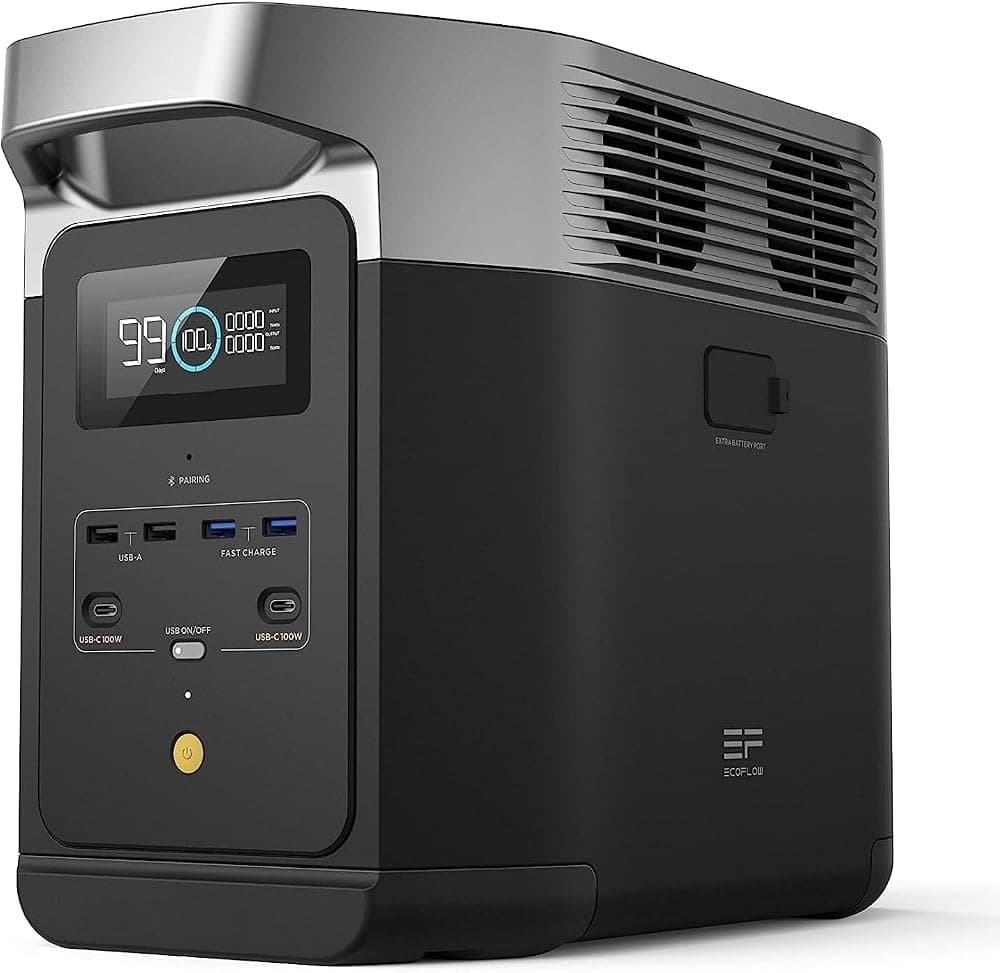
If the tailgate involves electric cooking, a fridge, or multiple TVs across two setups, step up to the 1,024Wh class. The EcoFlow Delta 2 (about $430-499, 1,024Wh, 1,800W output) is the benchmark here, with over 5,000 reviews on Amazon and a 4.7 average. The Anker SOLIX C1000 (about $430, 1,056Wh) and the Bluetti AC180 (about $449, 1,152Wh) are the direct competitors, and the Jackery Explorer 1000 v2 (about $447, 1,070Wh) is the ecosystem pick. These run an air fryer or a small induction burner for a meal, then still have battery left for the TV.
The r/overlanding thread about tailgate power echoes the size down: the EcoFlow Delta 2 shows up repeatedly as the unit that balances cost and capability. For a tailgate it is overkill for the TV alone, and exactly right if cooking is part of the ritual. The tailgate-focused generator roundups reach the same budget line, naming the 600W Anker 521 for smaller tailgates and the EcoFlow Delta 2 Max when a crew and a full rig are coming.
What to Check Before You Buy
Three things matter for tailgating specifically, beyond the size math. First, the inverter's continuous output rating, not just the peak. A station rated 1,800W continuous with a 3,600W peak is different from one with a marketing-friendly surge number. Second, the recharge time. Tailgates are spontaneous, and nobody plans a 10-hour wall charge. Modern stations hit 80% in about an hour, and that matters more than total capacity for this use case. Third, portability. A 35-pound 1kWh unit is fine for a truck bed. A 60-pound one is not. Weight is the tailgate tax you pay every single trip.
The Generator community's own guide to tailgate power frames the choice well: inverter generators are quiet, gas generators are cheap and loud, and battery stations are the silent option that starts at zero maintenance. If you pick battery, match the size to the TV, not to the fear of a dead lot.
Frequently Asked Questions
Will a 300Wh power station run a TV for a whole tailgate?
A 300-500Wh station runs a 50W TV plus speakers for three to five hours. The r/Generator crowd consistently quotes a couple hundred watt-hours as enough for a 32-inch TV for a few hours. Size up only if you are also running a fridge or electric cooking.
Can a power station run an air fryer at a tailgate?
Only the 1kWh class can, because air fryers draw roughly 1,400-1,700W. You need a station with at least that much continuous output, meaning the EcoFlow Delta 2, Anker SOLIX C1000, or similar. A 300-500Wh station will trip its inverter trying.
Are power stations allowed at tailgates?
Battery stations are almost always allowed where gas generators are restricted or banned, because they make no noise and emit nothing. Check your specific stadium or lot rules, since some lots regulate all generators. An r/CFB thread on the subject is unanimous that battery is the hassle-free option.
How long does it take to recharge a power station between tailgates?
Newer LiFePO4 stations recharge to 80% in roughly an hour. Older or cheaper units can take five hours or more. If your tailgate schedule is tight, prioritize fast AC charging over raw capacity.
What size power station do most people actually need for a tailgate?
Most tailgaters run a TV, speakers, and phones, which adds to about 100W. A 300-500Wh station covers that for a full game. The 1kWh tier is for electric cooking or fridge duty. Buying a 2,000Wh flagship for a TV-only tailgate is paying for a number you will never use.
The Bottom Line
Size the station to the TV and the grill, not to the spec sheet. For the majority of tailgates, a $230 Jackery Explorer 300 or a similar 300-500Wh unit is the honest answer, and the 1kWh class only earns its weight when electric cooking joins the party. When you have it down to two models, drop them into Versa AI and get the owner-experience read that the watt-hours table skips.
Shop smarter with Ask Versa AI
Get occasional product-comparison tips and new features as they ship. No spam.