Roborock Saros Z70 vs Dreame X50 Ultra: Arm or Legs?
The Roborock Saros Z70's OmniGrip arm takes on the Dreame X50 Ultra's ProLeap legs. Suction, mopping, climbing, battery reality, and Sept 2026 pricing.
By the Ask Versa AI Editorial Team. Ask Versa AI content is AI-assisted and editorially reviewed before publishing; specs and review sentiment are pulled live from Amazon.
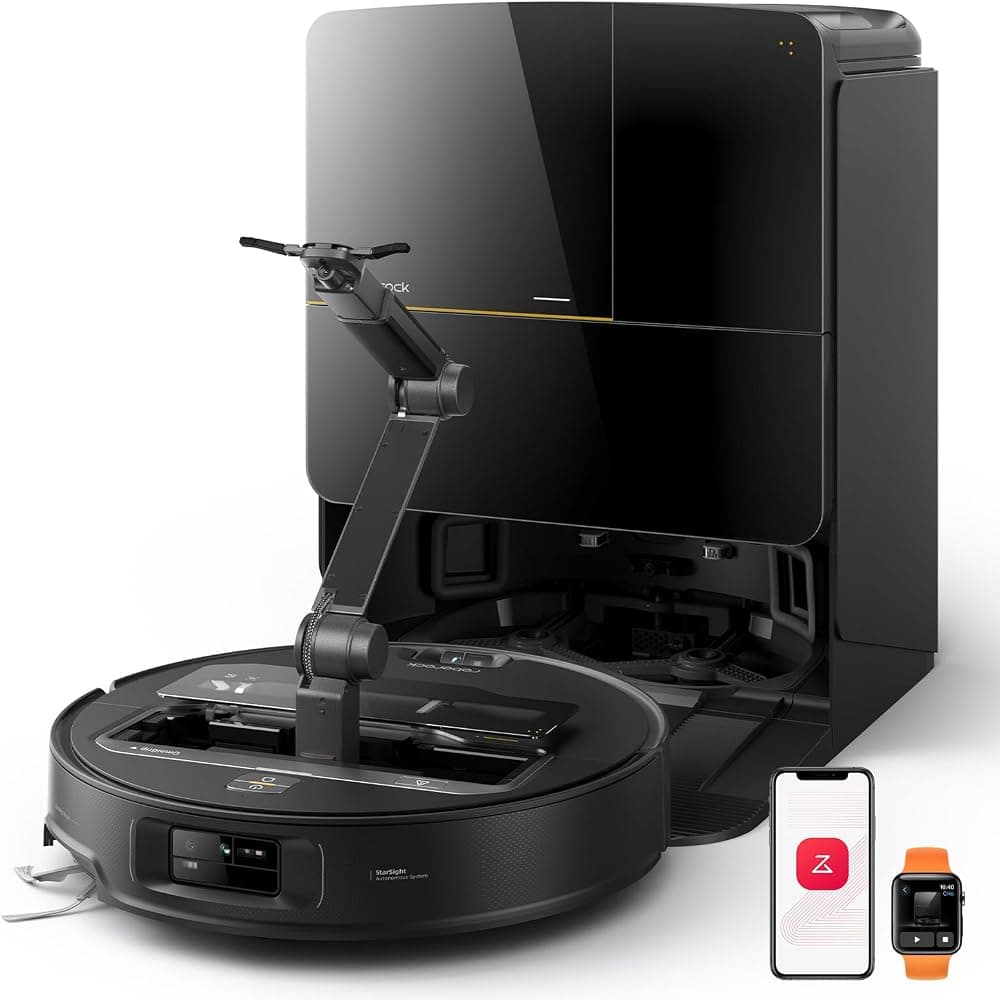
The two most expensive robot vacuums of 2026 arrived at the top of the market by solving the same problem in opposite ways. Roborock bolted a five-axis robotic arm onto the Saros Z70 so it can pick obstacles up and carry them out of the cleaning path. Dreame fitted the X50 Ultra with articulated legs so it can climb over thresholds and steps instead of stopping at them. Everything else about this matchup, including the $400-to-$1,100 price gap between them, flows from which of those two bets fits your house.
The arm and the legs are what you're paying for, so this comparison spends most of its time on what each one delivers in real homes, and whether the rest of the machine justifies the sticker. (Spoiler that should not be a spoiler: both companies shipped excellent cleaners underneath the party trick.)
Spec Comparison
| Spec | Roborock Saros Z70 | Dreame X50 Ultra |
|---|---|---|
| Suction | 22,000 Pa HyperForce | 20,000 Pa |
| Headline feature | OmniGrip 5-axis arm, lifts up to 300g | ProLeap legs, climbs up to 6cm |
| Threshold climbing | 30mm single / 40mm split | 42mm single / 60mm double step |
| Body height | 3.14 in (7.98 cm) | 3.5 in (8.9 cm), tower retracted |
| Navigation | StarSight 2.0 solid-state lidar, no tower | VersaLift retractable lidar tower |
| Obstacle recognition | 100+ object types, top-tier in tests | Weaker on crumpled paper, thin cables |
| Mopping | Dual spinning mops, 22mm AdaptiLift lift | Extending mop and side brush |
| Dock | Dock 4.0: empty, wash, dry, fill/drain | ThermoHub: empty, 212°F wash, dry, optional plumbing |
| Dustbin | Not a headline spec | 395 ml |
| Noise | Not headline spec | 65 dB |
| Battery | Not the selling point | 200 min rated, ~100 min measured |
| Price (Sept 2026) | $2,599 MSRP, $1,299-1,999 street | $899.99 street, launched at $1,699.99 |
A few cells need context. Roborock does not headline bin size or runtime for the Z70 because the arm is the story; Dreame's 200-minute rating is the number the spec sheet advertises and the number owners report halving in practice. Neither blank should be read as a weakness where the manufacturer simply hasn't staked its claim.
The OmniGrip Arm Picks Up Socks, Slowly
The Z70 is the first mass-produced robot vacuum with a robotic arm, and the OmniGrip system is a genuine engineering first: five axes of motion, a gripper that closes around small objects, and a built-in weight sensor rated for items up to 300 grams. You designate drop points in the app, and the robot ferries clutter there before vacuuming the floor underneath.
The catch is how narrow the working envelope is. Across reviewer testing, the arm's grab success rate lands around 50 percent, and the list of objects it handles reliably is short: socks, balled-up tissues, small towels, sandals or slippers. The arm needs vertical clearance above an object to descend and grip, so anything lying flat or tucked under low furniture is out of reach. Each pick-and-carry cycle is slow enough that you'll watch the first time and skip watching every time after.
That is why the reviewer consensus has settled where it has: buy the Z70 as a cleaner and treat the arm as a bonus. The cleaning hardware underneath is close to the best in the business, which we'll get to. But it's worth being honest that the arm is a first-generation feature, closer to a public beta than a finished capability.
The arm also forced compromises Roborock would not otherwise have made. Sitting on top of the chassis, it displaced the suction and climbing headroom that went to the armless Saros 20 instead: that sibling flagship offers 36,000 Pa and 45mm/88mm obstacle climbing for around $1,599, versus the Z70's 22,000 Pa and 30mm/40mm. Paying more for the Z70 buys the arm, and pays for it with the two numbers vacuum shoppers usually compare first.
ProLeap: Legs That Earn Their Keep
Dreame's bet ages better. The X50 Ultra's ProLeap system lifts the robot over 4.2cm single thresholds and up 6cm double-layer steps, which was a production-robot record when it launched, and it does this repeatedly, reliably, without drama. Where the Z70's arm clears the odd sock from the path, the X50's legs remove the path's physical limits entirely: the kitchen transition strip, the bathroom lip, the sunken living room edge that stranded every robot you've owned before this one.
One clarification worth making because marketing leans on it: 6cm is not a staircase. ProLeap handles thresholds and single step edges, not the 15-20cm risers of actual stairs. No mass-market robot vacuums climbs a full flight in 2026.
The legs work alongside VersaLift, a lidar tower that retracts when the robot drives under furniture, dropping the body to 3.5 inches. It's the same under-the-couch mission as Roborock's low-slung chassis, achieved with moving parts instead of a slim profile. That trade, fewer compromises on navigation height in exchange for more mechanisms that can fail, runs through the whole X50 Ultra.
Where the Z70 Is the Better Cleaner
Strip away both gimmicks and the Z70 wins the cleaning contest on most days. Its StarSight Autonomous System 2.0 uses a solid-state lidar with no raised tower at all, keeps the body at 3.14 inches so it slides under beds and sofas without retracting anything, and recognizes more than 100 obstacle types, placing it among the best avoidance performers reviewers have tested. The X50 Ultra, by contrast, gets rescued by its avoidance system more often than a machine at this price should, with crumpled paper and thin cables being the recurring blind spots in owner reports.
Mopping goes the same way. The Z70's dual spinning mops and AdaptiLift chassis, which raises the pads 22mm to keep them off carpet, scored 139 points in Vacuum Wars' dried-stain mopping test, second overall and well ahead of Roborock's own Saros 10R at 103. The X50 Ultra fights back with logistics rather than scrubbing: its ThermoHub dock washes the mops in near-boiling 212°F water, hot-air dries them, and can plumb into your water supply so you never fill a tank. If you hate maintaining a mop robot more than you hate mopping, that dock is a real argument.
Add the software layer and the gap widens. Roborock's app is cleaner and more stable than Dreame's, and its support reputation is better, which matters for a machine full of motors.
The X50 Ultra's Rough Edges
Battery life is the complaint X50 Ultra owners raise most, and the numbers back them up. Dreame rates the robot for 200 minutes, but in Clean Genius mode owners consistently measure around 1 percent battery per minute, which works out to roughly 100 minutes of real cleaning. Large homes see mid-run docking and recharging, which stretches a full-house pass well past its scheduled window.
The service stories are harder to quantify but easy to find: threads on r/robotvacuums include owners who have cycled through multiple replacement units, one through four, chasing the same faults. Dreame's app is busier and buggier than Roborock's. And a robot that carries legs, a retracting tower, and extending mop arms has more mechanisms that can eventually need repair than a simpler chassis does. The 23-inch dock is also a beast to hide in a small kitchen.
The counterweight is real too. In one 35-hour long-term test in a multi-pet home, the X50 Ultra's DuoBrush dual-rubber system logged zero hair-jam stalls, and the $899.99 street price forgives a lot. Every flaw listed above also applies, in some form, to flagships that cost $600 more.
The Price Gap Does Most of the Talking
As of September 2026 the X50 Ultra sells for $899.99 against a $1,699.99 launch price, with the Complete bundle having dipped to $824 and refurbs hovering near $560. The Saros Z70 lists at $2,599 and realistically sells between $1,299 at aggressive retailers and about $1,999 on Amazon. The suction difference between them is 2,000 Pa, which most floors will not notice.
The awkward part of the Z70's pricing is internal. The armless Saros 20 at ~$1,599 out-suctions it by 14,000 Pa, out-climbs it (45mm/88mm versus 30mm/40mm), and review consensus says it's the stronger pure cleaner. So the Z70's premium over its own sibling buys exactly one thing: the arm, at 50 percent reliability, plus StarSight navigation. Whether that trade makes sense is a question about enthusiasm, not value.
Which One Belongs in Your House
For most shoppers cross-shopping these two, the X50 Ultra at ~$899 is the rational purchase. Its legs are the mature version of the futuristic feature, its cleaning is close enough on every metric that matters, and it costs $400 to $1,100 less. If your home has thresholds, split-level edges, or transition strips between rooms, stop reading here: the legs are not a gimmick in your house, they're the difference between a robot that cleans most of the floor and one that cleans all of it.
The Z70 earns its price in one specific situation: a flat, single-level home with lots of low furniture, an owner who wants the best obstacle avoidance and near-best mopping available, and a street price near the $1,299 end of its range. In that setting the 3.14-inch body, StarSight avoidance, and 139-point mopping are class-leading, and the arm becomes an occasional delight rather than a letdown. At $1,999, pass.
And the honest third branch: if you mainly want the cleanest floors per dollar and feel no pull toward either headline feature, neither robot is the right buy. The Saros 10R, the Saros 20, or a discounted Qrevo Curv clean as well or better for less money, a point our robot vacuum buying guide covers in more depth. Paying flagship money only makes sense when the flagship feature matches your floorplan.
Frequently Asked Questions
Is the Roborock Saros Z70 worth it?
As a cleaner, yes: it has arguably the best obstacle avoidance of any robot vacuum in 2026 and second-place mopping in Vacuum Wars' dried-stain testing. As a robotic arm demo, not yet. At a $1,299 street price it's defensible; at $1,999 and up, the armless Saros 20 out-cleans it for around $1,599.
Can the Dreame X50 Ultra climb stairs?
No. ProLeap legs lift it over thresholds up to 4.2cm and double-layer steps up to 6cm, a production-robot record at launch. Full staircases with 15-20cm risers remain beyond every mass-market robot vacuum.
Does the OmniGrip robotic arm actually work?
About half the time. Reviewer testing puts grab success near 50 percent, with reliable performance limited to socks, balled tissues, small towels, and slippers under 300g. It also needs vertical clearance above an object, so items lying flat or under low furniture stay where they are.
Which one is better for pet hair?
Both use dual rubber anti-tangle brush systems, so both handle shedding well. The X50 Ultra has the documented endurance: a 35-hour long-term test in a multi-pet home recorded zero hair-jam stops, and its hot-water dock keeps the mops from getting grimy.
How long does the Dreame X50 Ultra really run?
Dreame rates it at 200 minutes, but owners measuring in Clean Genius mode see about 1 percent battery drain per minute, or roughly 100 minutes of cleaning. Large homes should expect a mid-run recharge during full-house passes.
Torn between these two, or weighing a cheaper Roborock against them? Drop both product links into Versa AI and it scores the spec wins and real review sentiment in one report, so the floorplan decision gets made on evidence instead of launch-day hype.
Shop smarter with Ask Versa AI
Get occasional product-comparison tips and new features as they ship. No spam.